Name
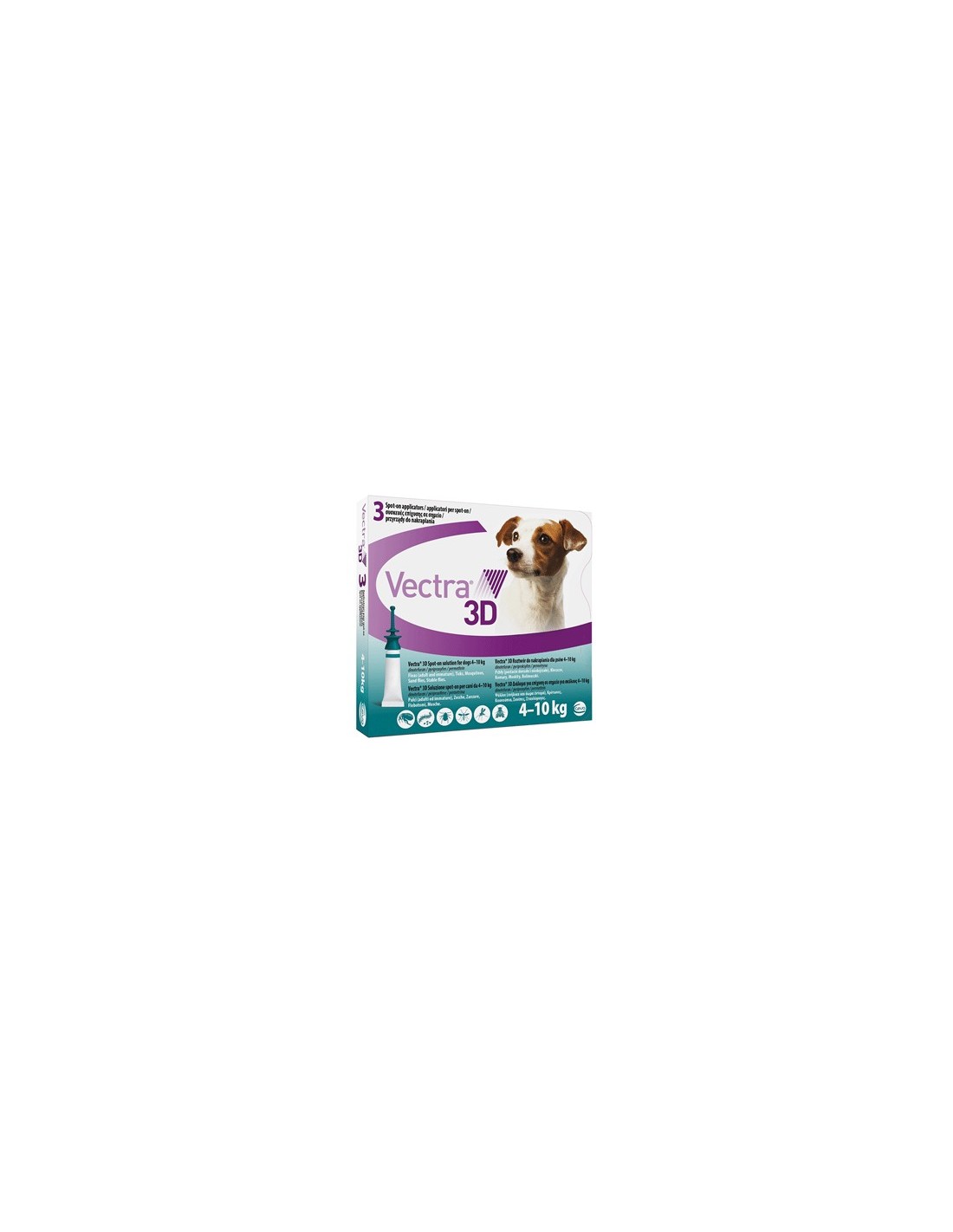
VECTRA 3D
Pharmacotherapeutic Category
Ectoparasiticides for topical use.
Active Ingredients
Dinotefuran, pyriproxyfen, permethrin.
Excipients
N-octyl-2-pyrrolidone, N-methylpyrrolidone.
Indications
Fleas: treatment and prevention of flea infestation (Ctenocephalides felis and Ctenocephalides canis). The treatment prevents flea infestation for one month. It also prevents flea multiplication for two months after application by inhibiting egg hatching (ovicidal activity) and by inhibiting the emergence of adults from eggs laid by adult fleas (larvicidal activity). The veterinary medicinal product can be used as part of a treatment strategy for flea allergy dermatitis (FAD). Ticks: the veterinary medicinal product has persistent acaricidal efficacy and repellent action against tick infestations (Rhipicephalus sanguineus and Ixodes ricinus for one month, and Dermacentor reticulatus for up to three weeks). If ticks are present when the veterinary medicinal product is applied, they may not all be killed within the first 48 hours but may die within a week. To remove ticks, the use of a suitable tick removal device is recommended. Sandflies, mosquitoes and stable flies: the treatment provides persistent repellent (anti-feeding) activity. It prevents bites from sandflies (Phlebotomus perniciosus), mosquitoes (Culex pipiens, Aedes aegypti) and stable flies (Stomoxys calcitrans) for one month after application. The treatment also provides persistent insecticidal activity for one month against mosquitoes (Aedes aegypti) and stable flies (Stomoxys calcitrans).
Contraindications/Undesirable Effects
Do not use in cases of hypersensitivity to one or more of the active substances or to any of the excipients. Do not use on cats. Due to their unique physiology and inability to metabolise permethrin, this veterinary medicinal product must not be used on cats. If applied to a cat, or ingested by a cat that has actively rubbed against a recently treated dog, this veterinary medicinal product may cause serious harmful reactions.
Dosage
The minimum recommended dose is 6.4 mg dinotefuran/kg body weight, 0.6 mg pyriproxyfen/kg body weight and 46.6 mg permethrin/kg body weight, equivalent to 0.12 ml of the veterinary medicinal product per kg of body weight. Use the appropriate pack according to the animal's body weight. Take care to apply the veterinary medicinal product only to intact skin. Avoid superficial application to the dog's coat. Treatment schedule: following a single application, the veterinary medicinal product will prevent infestation for one month. The treatment can be repeated once a month.
Storage
This veterinary medicinal product does not require any special storage conditions.
Warnings
All dogs in the household should be treated. Cats in the household should only be treated with a veterinary medicinal product authorised for use in that species. Fleas can infest the dog's basket, bedding and usual resting areas such as carpets, sofas and armchairs. In case of massive flea infestation and at the start of control measures, these areas should be treated with a suitable insecticide and then vacuumed regularly. In cats, this veterinary medicinal product may induce convulsions which can be fatal, owing to the unique physiology of this species, which is unable to metabolise certain compounds, including permethrin. In case of accidental exposure, if undesirable effects appear, wash the cat with shampoo or soap. To prevent cats from accidentally coming into contact with this veterinary medicinal product, keep cats away from treated dogs until the application site is dry. It is important to make sure that cats do not rub against the application site of a dog that has been treated with this veterinary medicinal product. The safety of this veterinary medicinal product has not been established in dogs under 7 weeks of age or weighing less than 1.5 kg. Care should be taken to avoid contact between this veterinary medicinal product and the dog's eyes. The attachment of a single tick after treatment cannot be excluded. For this reason, the transmission of infectious diseases cannot be completely excluded if conditions are favourable. The veterinary medicinal product remains effective when treated animals are immersed in water (e.g. when swimming or bathing). Weekly immersion in water for one month, starting 48 hours after treatment, as well as shampooing 2 weeks after treatment, has no effect on the efficacy of this product. However, the duration of efficacy may be reduced in case of frequent shampooing or bathing within 48 hours after treatment. Special precautions for the person administering the product to animals: do not eat, drink or smoke when handling the veterinary medicinal product. Wash hands thoroughly and immediately after use. This veterinary medicinal product causes eye and skin irritation. Avoid contact with the skin. In case of accidental spillage onto the skin, wash immediately with soap and water. If the veterinary medicinal product accidentally comes into contact with the eyes, they should be rinsed thoroughly with water. If eye or skin irritation persists, or if the veterinary medicinal product is accidentally swallowed, seek medical advice immediately and show the package leaflet or the label to the doctor. People with known hypersensitivity to any of the components should avoid contact with the veterinary medicinal product. Children must not touch treated dogs for at least four hours after administration of the veterinary medicinal product. It is therefore advisable to treat dogs in the evening, or before taking them for a walk. On the day of treatment, treated dogs should not be allowed to sleep with their owners, especially children. Used applicators should be disposed of immediately and not left in sight or within reach of children. Wait for the application site to dry before allowing treated dogs to come into contact with fabrics or objects. Other precautions: treated dogs should not be allowed to enter watercourses for 48 hours after treatment to avoid adverse reactions in aquatic organisms. Overdose: apart from erythema and changes in the appearance of the coat, no adverse reactions were observed in healthy 7-week-old puppies treated topically 7 times at 2-week intervals and at up to 5 times the maximum recommended dose. In case of accidental ingestion at the maximum recommended dose, vomiting, salivation and diarrhoea may occur, which should however disappear without treatment. Incompatibilities: do not mix with other veterinary medicinal products and do not apply together with other veterinary medicinal products simultaneously and at the same site.
Withdrawal Periods
Not applicable.
Target Species
Dogs.
Interactions
None known.
Undesirable Effects
Erythema, itching or other transient signs of discomfort at the application site have been reported very rarely (fewer than 1 animal in 10,000, including isolated reports), usually disappearing spontaneously within 24 hours of administration. Gastrointestinal symptoms such as vomiting or diarrhoea have also been reported very rarely. Transient cosmetic effects (greasy, tousled appearance of the coat and deposits) at the application site have been reported very rarely; however, these effects are usually no longer visible after 48 hours.
Pregnancy and Lactation
The safety of the veterinary medicinal product has not been established in bitches during pregnancy and lactation. Use of the veterinary medicinal product in pregnant and lactating bitches or in dogs intended for breeding should be based on a benefit/risk assessment. Laboratory studies with each of the components, dinotefuran, pyriproxyfen or permethrin, in rats and rabbits have not shown any maternotoxic, teratogenic or foetotoxic effects. Dinotefuran has been shown to cross the blood-milk barrier and to be excreted in milk. N-methylpyrrolidone, an excipient of the veterinary medicinal product, has shown teratogenicity in laboratory animals.