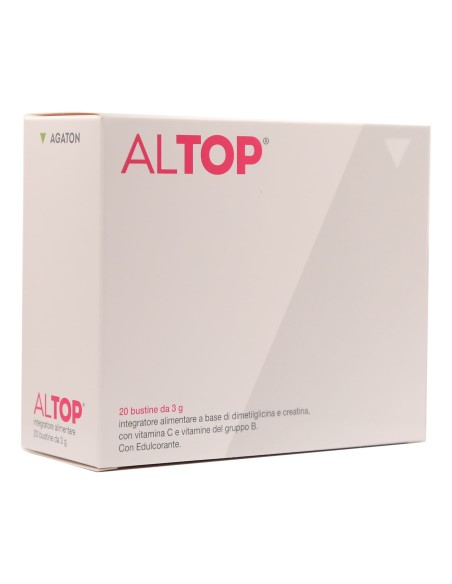
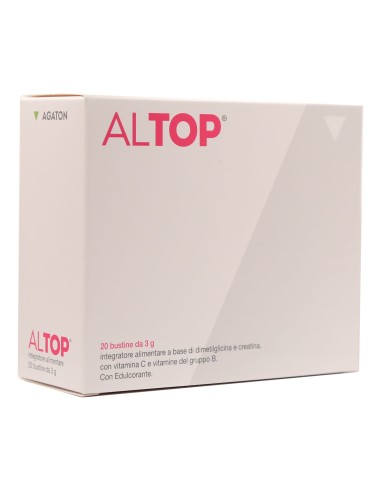
ALTOP
A food supplement that helps you recover your strength, both physically and mentally. The heart of ALTOP is dimethylglycine, a natural substance of the betaine class, extracted from common beetroot, beta vulgaris. The Italian Ministry of Health (Ministero della Salute) attributes a very specific indication to dimethylglycine: it has a supporting and restorative effect1. Thanks to its ability to donate methyl groups, dimethylglycine may enhance cellular metabolism, supporting energy production at all levels2. Dimethylglycine is also a lipophilic molecule that crosses the blood-brain barrier and therefore also exerts its pro-energy action in the brain; indeed, numerous scientific studies have explored its use in the neurological field3,4. Adding dimethylglycine to the daily diet is therefore useful in states of mental and physical stress, and during rehabilitation and convalescence, to help recover strength. The ALTOP formulation is completed by significant doses of B vitamins (150% RDA) and vitamin C (300%), and a small amount of creatine, to enhance the pro-energy effect, with no time limits on use. The components of ALTOP are therefore a useful support for students, older people, those who are run down, or those regularly undertaking intense physical effort, such as sportspeople.
It is best avoided during pregnancy, while it can be taken during breastfeeding. It can be taken by people with diabetes. It is not a doping substance. Contains sucralose.
Ingredients
Dimethylglycine; creatine; vitamin C; B vitamins.
Directions for use
1 or 2 tablets a day, as needed, without exceeding the maximum daily dose of 2 tablets. It can be taken for prolonged periods only after consulting a doctor.
Warnings
Do not exceed the recommended daily dose.
Keep out of the reach of children under 3 years of age.
Supplements should not be used as a substitute for a varied diet.
Pack size
20 tablets.
References
- 1. List of substances with nutritional or physiological effect usable in food supplements (Elenco sostanze ad effetto nutritivo o fisiologico impiegabili negli integratori alimentari), 2012. Italian Ministry of Health.
- 2. Kendall, R. V. and Lawson, J. W., Recent Findings on N,N-Dimethylgycine (DMG): A Nutrient for the New Millennium. Department of Microbiology and Molecular Medicine, Clemson University and Food Science Corporation, 2010.
- 3. Roach, E., and Carlin, L. N,N-Dimethylglycine for Epilepsy. New England Journal of Medicine. 307:1081, 1982.
- 4. Rimland, B. Dimethylglycine, a nontoxic metabolite, and autism. Research Review International. 4(#3), 1990.