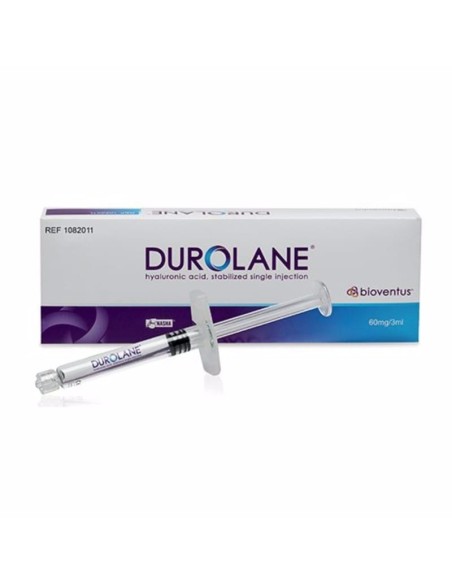
DUROLANE
Class III CE 0086 medical device.
Durolane is intended for intra-articular injection for the symptomatic treatment of mild to moderate osteoarthritis of the knee or hip. It is also intended for intra-articular injection for the symptomatic treatment of mild to moderate osteoarthritis of the indicated synovial joints and for the reduction of pain following arthroscopic procedures. The product must be injected by a qualified doctor or in accordance with local legislation. Durolane contains 20 mg/ml of stabilised non-animal hyaluronic acid in buffered physiological sodium chloride solution, pH 7. It is a sterile, transparent viscoelastic gel supplied in a 3 ml glass syringe. The product is for single use only. Hyaluronic acid is identical in all living organisms. It is a natural polysaccharide found in the body's tissues, with particularly high concentrations in synovial fluid and skin. Durolane is composed of biosynthetically produced, purified and stabilised hyaluronic acid. Durolane is broken down by the body via the same metabolic pathway as endogenous hyaluronic acid.
Contents
Each ml contains:
Stabilised hyaluronic acid 20 mg, physiological sodium chloride solution, pH 7 q.s.
Mode of action
The body's hyaluronic acid is a natural part of the synovial fluid and acts in the joints both as a lubricant for cartilage and ligaments and as a shock absorber. Injections of hyaluronic acid into the joint to restore viscosity and elasticity can reduce pain and improve joint mobility.
Dosage
Durolane is a single-dose preparation for single injection and must be injected only once per treatment. The recommended dose is 3 ml per knee, hip or shoulder joint. The recommended dose is 1-2 ml for intermediate joints (e.g. elbow, ankle) and approximately 1 ml for small synovial joints (e.g. thumb).
Indications
Symptomatic treatment of mild to moderate osteoarthritis of the knee or hip. The product has also been approved for the symptomatic treatment of mild to moderate osteoarthritis of the ankle, shoulder, elbow, wrist, fingers and toes. Durolane is also indicated for the treatment of pain following arthroscopy, both in the presence of osteoarthritis and following general surgical repair, within 3 months of the procedure.
Contraindications
No known contraindications.
Warnings
- Must not be injected if the synovial joint is infected or severely inflamed.
- Must not be injected in the presence of active skin disease or infection at or near the injection site.
- Must not be injected intravascularly or extra-articularly, or into the synovial capsules or tissues.
- Do not resterilise Durolane, as this may damage the product.
- It is a single-use product and must not be resterilised. Once the syringe has been removed from the pack, use immediately.
- Do not use the product if the blister pack or syringe is open or damaged. The syringe and any unused material must be discarded immediately after the treatment session and must not be reused, to avoid the risk of contamination of unused material and the related risk of infection. Dispose of the product in accordance with accepted medical practice and current national, local or institutional guidelines.
Precautions
- Use with caution in patients with venous or lymphatic stasis in the leg.
- Has not been tested in pregnant or breastfeeding women or in children.
- A separate DUROLANE syringe must be used for each joint to be treated.
- As with any invasive joint procedure, there is a slight risk of infection.
- Durolane must not be injected in patients with known sensitivity to hyaluronic acid products.
- The use of local anaesthetics is not recommended if the patient is allergic or sensitive to them.
- Injection under fluoroscopic guidance with contrast medium is not recommended if the patient is allergic or sensitive to the contrast medium.
- In clinical studies, the effects of repeat injections in the knee at an interval of less than 6 months between the first and second injection have not been studied.
- Increased injection pressure may indicate incorrect extra-articular placement of the needle or overfilling of the joint.
- The effectiveness of Durolane following purely diagnostic or examination arthroscopic procedures has not been established.
- Durolane should be used with caution in patients with pre-existing chondrocalcinosis, as the injection may trigger an acute attack of this condition.
Side effects
Most side effects observed in knee and hip clinical studies were described as transient pain, swelling and/or stiffness localised to the joint. These side effects were mild to moderate in intensity and only occasionally required treatment with painkillers or NSAIDs. The use of other hyaluronic acid preparations in other joints has not shown any additional exclusive side effects. None of the other reported side effects were interpreted as acute inflammatory arthritis or allergic reaction, nor did they require medical attention in the form of surgery or the administration of systemic or intra-articular steroids or antibiotics.
Interactions
The safety and effectiveness of Durolane in combination with other intra-articular injectable products have not been established.
Administration
General information on administration.
- Durolane must only be injected by a qualified doctor (or in accordance with local legislation) experienced in the intra-articular injection technique for the synovial joints to be treated, in clinics suitably equipped for intra-articular injections.
- It must be injected using an aseptic technique.
- It must be injected only into the joint cavity.
- Intra-articular injection into certain synovial joints requires image guidance to ensure accurate placement and avoid damaging adjacent vital structures.
- The intra-articular injection site, with or without image guidance, must be chosen so as to avoid damaging adjacent vital structures.
- Before injection, treat the injection site with alcohol or another antiseptic solution.
- Remove any joint effusion before injecting Durolane. The same needle must be used to remove the effusion and to inject Durolane.
- Use a needle of appropriate length, preferably between 18 and 22 G.
- Using smaller needles increases the pressure needed to administer the product.
Additional information on the treatment of synovial joints requiring image guidance.
- Intra-articular injection into the hip joints must be performed under fluoroscopic (preferably with contrast medium) or ultrasound guidance to ensure correct placement of the needle in the joint cavity.
- In other synovial joints, the use of image guidance is at the discretion of the treating doctor.
- Discomfort from the injection can be minimised by using topical cooling agents or subcutaneously administered local anaesthetics.
- Image-guided injection must only be performed by doctors experienced in this type of administration.
Additional information for post-arthroscopy treatment.
- Following the arthroscopic procedure, the intra-articular injection must be performed outside the sterile field, as the outside of the syringe is not sterile.
- The joints that generally undergo arthroscopic procedures are the knee, hip, shoulder, elbow, ankle and wrist.
Please inform the patient that:
- as with any invasive joint procedure, strenuous physical activity (e.g. tennis, jogging or long walks) should be avoided for the first 2 days after the injection.
- During the first week after the injection, some transient reactions related to the Durolane injection may occur, such as mild to moderate pain and/or swelling/stiffness. If symptoms persist for more than one week, consult a doctor.
Performance
- Clinical studies of Durolane for osteoarthritis of the knee and hip showed a significant average benefit, such as reduced knee and hip pain and improved physical function compared with baseline clinical values recorded 6 months after treatment.
- Studies analysing repeat treatment of the knee 6 months after the first injection did not show an increase in side effects.
- In controlled trials of Durolane for knee osteoarthritis, notable benefits in the "responder rate" were observed compared with saline solution, and non-inferior results compared with corticosteroids in a widely adopted high-efficacy patient population.
- Clinical studies of other hyaluronic acid preparations similar to Durolane in joints other than the knee and hip for the treatment of osteoarthritis and post-arthroscopy indicate average benefits compared with baseline values. Specific studies have also shown improvements in favour of the hyaluronic acid group compared with control therapy, for example saline solution and corticosteroids. Six months after treatment, improvements such as reduced pain and improved physical function were observed.
- The half-life of Durolane in human knees is approximately four (4) weeks.
Storage and expiry
Durolane must be stored in its original packaging at a temperature not exceeding 30 °C. The expiry date is shown on the pack and the product must not be used after that date. Do not freeze.
Pack size
Pack:
Durolane is supplied in a 3 ml glass syringe with Luer-lok fitting, in a blister pack. The contents of the syringe are sterile. The outside of the syringe is not sterile.
Code 1082010