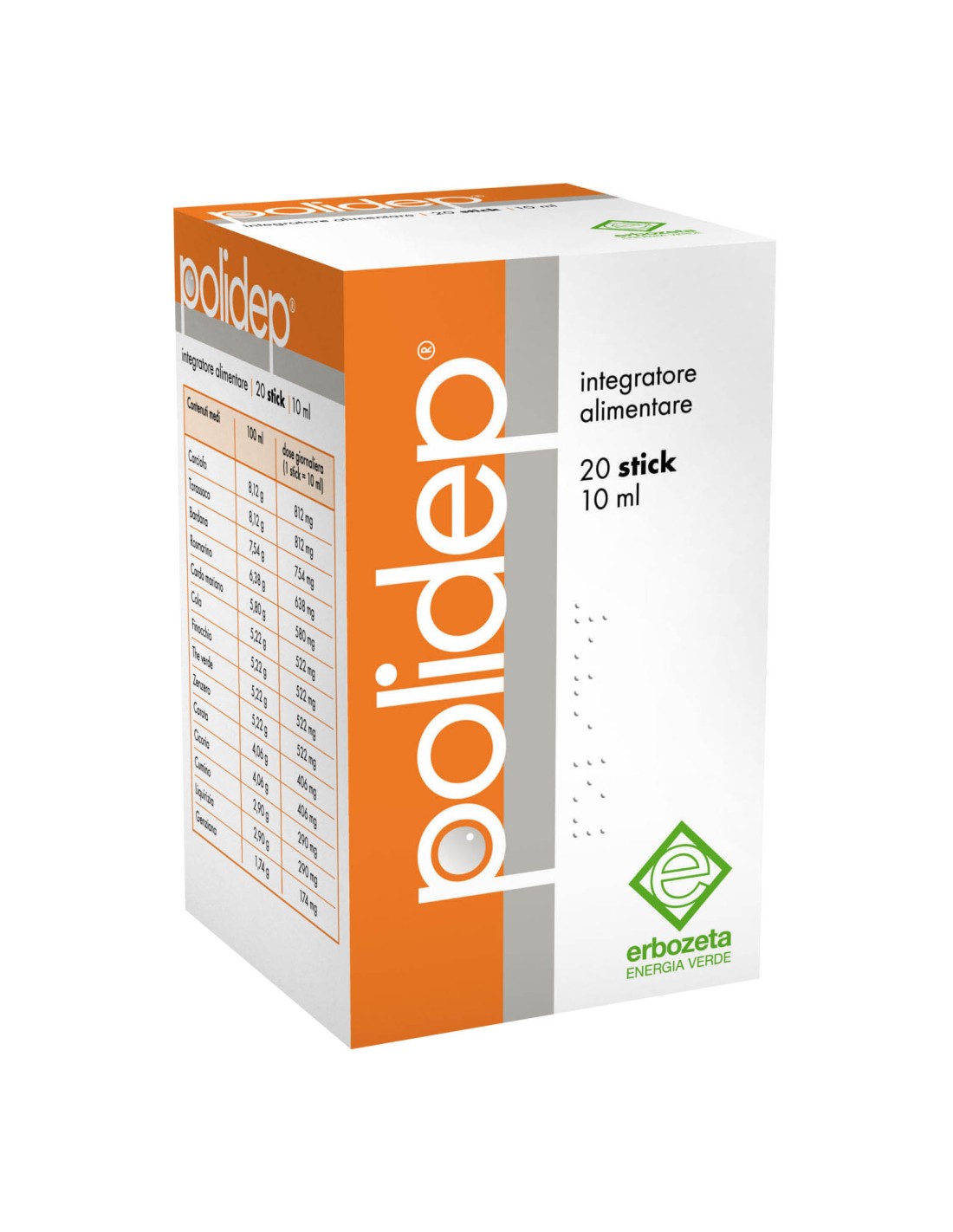
polidep
Food supplement that supports purification, drainage and the elimination of toxins by the emunctory organs, boosting diuresis, liver activity, intestinal transit and skin function. Gluten-free.
Artichoke As a choleretic, bile flow regulator and liver protector, it is useful in hepatobiliary disorders. Its choleretic and liver-protective action works through its activity on urea metabolism: it helps reduce blood nitrogen by stimulating the hepatic conversion of nitrogenous molecules imperfectly processed by the liver, poorly diffusible through the kidney, into urea, which is less toxic and diffuses through the kidney.
Burdock It is known above all for its draining action on the skin. Thanks to this activity it is particularly useful for acne, eczema and seborrhoea. It also has diuretic and cholagogue action.
Dandelion It is known for its choleretic, cholagogue and liver-protective properties. Thanks to its draining and purifying properties it is useful during weight-loss diets. The bitter principles it contains also stimulate the initial phase of digestion and the production of saliva and gastric juices, making it useful for digestive complaints.
Rosemary It has cholagogue-choleretic and liver-protective properties. In particular, its liver-protective action is due to the inhibition of lipid peroxidation in microsomes and liposomes, especially in hepatocytes. Rosemary also has antispasmodic and antioxidant properties.
Milk thistle It is known for its liver-protective property, linked to Silymarin. It stimulates the production of new liver cells and stabilises both the hepatocyte membrane and that of cytoplasmic organelles, particularly lysosomes, inhibiting the leakage of lysosomal enzymes that are toxic to the cell. It also prevents toxic substances from entering the liver cell. Milk thistle also helps prevent free radical damage, inhibits lipid peroxidation and increases liver glutathione levels.
Cola It has diuretic, digestive and tonic properties. It is also used for weight loss and to reduce cellulite.
Fennel It increases salivary and gastric secretion, aiding digestion. It also has a carminative and calming action on gastrointestinal spasms. In particular, the trans-anethole it contains acts on the smooth muscle of the intestine, promoting motility and improving the progression of intestinal contents. At the same time it reduces the production of gas, responsible for meteorism and abdominal pain.
Green tea It has a marked diuretic and antioxidant action. It can also lower blood lipid levels: the polyphenols it contains are thought to increase adrenaline levels, which in turn increases lipolysis. Thanks to these properties it is used as an aid in weight-loss diets.
Ginger It can stimulate salivary and gastric secretions and peristalsis and improve the tone of the intestinal muscles. Thanks to its stomachic and prokinetic properties, it is useful in case of difficult digestion and aerophagia. It also has cholagogue and liver-protective activity.
Carrot It has a marked diuretic action: it increases urine volume and the amount of uric acid eliminated by 10%. It also has digestive properties and is characterised by a high concentration of Vitamin A.
Chicory A bitter-tonic plant, it is traditionally used for digestive difficulties, for its choleretic and cholagogue activity and for its diuretic action.
Cumin It is known for its carminative and digestive properties.
Liquorice Thanks to its antispasmodic action on intestinal smooth muscle, it is useful in case of digestive difficulties, bloating, slow digestion and aerophagia.
Gentian It contains bitter glycosides that stimulate the taste receptors and reflexively increase salivary and gastric secretion, thus improving digestive function. They also promote motility of the digestive tract, making them useful for slow digestion.
Ingredients Blend of plant extracts (supported on Fructooligosaccharides, Glycerin).
| | 100 ml | daily dose
(1 stick=10 ml) |
| Artichoke (Cynara scolymus) leaves | 8.12 g | 812 mg |
| Dandelion (Taraxacum officinalis) roots | 8.12 g | 812 mg |
| Burdock (Arctium lappa) roots | 7.54 g | 754 mg |
| Rosemary (Rosmarinus officinalis) leaves | 6.38 g | 638 mg |
| Milk thistle (Sylibum marianum) seeds | 5.80 g | 580 mg |
| Cola (Cola acuminata) nuts | 5.22 g | 522 mg |
| Fennel (Foeniculum vulgare) seeds | 5.22 g | 522 mg |
| Green tea (Camelia sinensis) leaves | 5.22 g | 522 mg |
| Ginger (Zingiber officinalis) rhizome | 5.22 g | 522 mg |
| Carrot (Daucus carota) roots | 4.06 g | 406 mg |
| Chicory (Cichorium intybus) roots | 4.06 g | 406 mg |
| Cumin (Cuminum cyminum) seeds | 2.90 g | 290 mg |
| Liquorice (Glycyrrhiza glabra) roots | 2.90 g | 290 mg |
| Gentian (Genziana lutea) roots | 1.74 g | 174 mg |
How to use Take 1 stick a day, neat or diluted in a glass of water.
Features Drainage allows the body to eliminate toxins through the emunctory organs: liver, kidneys, intestine and skin.
The result of good drainage is enhanced liver activity, bile secretion, diuresis and intestinal transit, and regulation of sebum secretion. A slowdown in the function of the emunctory organs, with the resulting accumulation of a pool of toxic and waste substances, can weaken the body. Drainage puts the body in a position to recover an altered balance and to respond optimally to treatments.
Format 20 Sticks of 10 ml.
Bibliography: - F.Fiorenzuoli, Le 100 erbe della salute, Tecniche nuove editore (2000).
- F. Capasso, G. Grandolini, A.A. Izzo, Fitoterapia impiego razionale delle droghe vegetali, Springer (2009).
- M. Murray, Il potere delle piante medicinali, Planta medica edizioni (II edizione).
- Campanini E., Dizionario di fitoterapia e piante medicinali, Tecniche nuove editore II edizione (2004).
- http://www.simn.org/schede_professionisti/professionisti_aloe.html.
- Lawless j., Allan j., Aloe vera le proprietà terapeutiche di una pianta versatile ed efficace, Tecniche nuove.
- Byeon S, Pelley R, Ullrich S, Waller T, Bucana C, Strickland R. Aloe barbadensis extracts reduce the production of interleukin-10 after exposure to ultraviolet radiation. J Invest Dermatol 1998; 110:811-17.
- Strickland F, Pelley R, Kripke M. Prevention of ultraviolet radiationinduced suppression of contact and delayed hypersensitivity by Aloe barbadensis gel extract. Journal of Investigative Dermatology 1994; 102:197-204.
- Strickland F, Pelley R, Kripke M. Prevention of ultraviolet radiationinduced suppression of contact and delayed hypersensitivity by Aloe barbadensis gel extract. Journal of Investigative Dermatology 1994; 102:197-204.
- Vazquez B, Avila G, Segura D, Escalante B. Antiinflammatory activity of extracts from Aloe vera gel. J Ethnopharmacol 1996; 55:69-75.
- Murgia V., Ventrigli G., Fitoterapia in pediatria, Masson (2006).
- http://www.simn.org/schede_professionisti/professionisti_calendula. html.
- Akhtar N., Zaman S.U., Khan B.A., Amir M.N., Ebrahimzadeh M.A. Calendula extract: effects on mechanical parameters of human skin. Acta Pol Pharm. 2011 Sep-Oct;68(5):693-701.
- Lawless j., Enciclopedia degli oli essenziali, Tecniche nuove.