Name
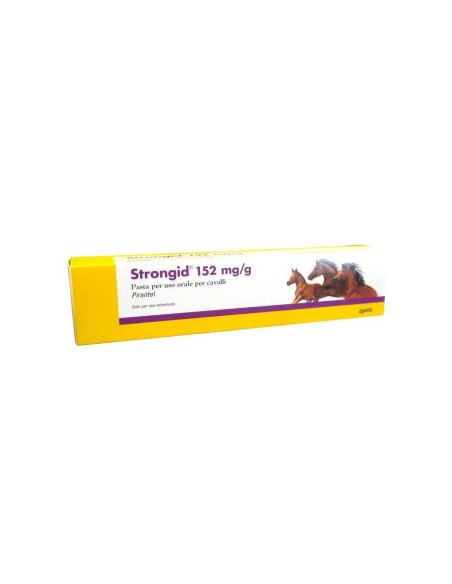
STRONGID 152 MG/G ORAL PASTE FOR HORSES
Pharmacotherapeutic Group
Anthelmintics.
Active Substances
Each g of paste contains: active substance pyrantel pamoate 439.00 mg (equivalent to pyrantel base 152.30 mg).
Excipients
Excipients. Qualitative composition of excipients and other constituents: methyl p-hydroxybenzoate; quantitative composition if essential for correct administration of the veterinary medicine: 1.05 mg. Qualitative composition of excipients and other constituents: propyl p-hydroxybenzoate; quantitative composition if essential for correct administration of the veterinary medicine: 0.30 mg. Qualitative composition of excipients and other constituents: polysorbate 80. Qualitative composition of excipients and other constituents: sorbitol solution. Qualitative composition of excipients and other constituents: sodium alginate. Qualitative composition of excipients and other constituents: purified water.
Indications
The veterinary medicine is indicated for the treatment and control of parasitic infections caused by: Strongylus vulgaris; Strongylus edentatus; Strongylus equinus; Cyathostomum spp. (Trichonema spp.); Triodontophorus spp.; Oxyuris spp.; Parascaris spp.; Anoplocephala perfoliata. The veterinary medicine is also effective against strains of small strongyles resistant to benzimidazoles.
Contraindications/Undesirable Effects
Do not use in cases of hypersensitivity to the active substance or to any of the excipients.
Safety in Target Species
No data available. Do not exceed the recommended doses.
Dosage
Oral use. It is not necessary to fast the animal before or after administration. The following method of administration is recommended: determine the weight of the animal to be treated as accurately as possible; set the dosing ring along the plunger according to the animal's weight; remove the cap from the syringe; deposit the paste on the back of the animal's tongue. To do this, insert the tip of the syringe through the corner of the mouth, direct the syringe towards the back of the oral cavity and press the plunger. When the veterinary medicine is administered with this technique, it is unlikely to be regurgitated. To aid swallowing, raise the animal's head by placing a hand under the jaw. The recommended dose for the treatment and control of strongyles, pinworms and ascarids (excluding tapeworms) is 6.6 mg of pyrantel base per kg of body weight. This dose is achieved by administering the veterinary medicine according to the following schedule. Body weight: 301 - 600 kg; dose: contents of 1 whole syringe; dosing ring position: 600 kg. Body weight: 150 - 300 kg; dose: contents of 1/2 syringe; dosing ring position: 300 kg. The recommended dose for the treatment and control of tapeworms (Anoplocephala perfoliata) is 13.2 mg of pyrantel base per kg of body weight (double the dose recommended for the treatment of strongyles). This dose is achieved by administering the veterinary medicine according to the following schedule. Body weight: up to 300 kg; dose: contents of 1 whole syringe; dosing ring position: 600 kg. Body weight: from 301 to 600 kg; dose: contents of 2 whole syringes; dosing ring position: 600 kg. Where the environment in which the animals live makes reinfection likely, the veterinary medicine should be administered every 4-6 weeks for best results.
Storage
Store below 25 °C. Protect from light. Shelf life of the veterinary medicine as packaged for sale: 36 months. Shelf life after first opening of the immediate packaging: use immediately.
Warnings
Care should be taken to avoid the following practices, as they increase the risk of development of resistance and could ultimately result in ineffective therapy: too frequent and repeated use of anthelmintics from the same class over an extended period of time; underdosing, which may be due to underestimation of body weight, misadministration of the veterinary medicine, or lack of calibration of the dosing device (if any). Suspected clinical cases of resistance to anthelmintics should be further investigated using appropriate tests (e.g. faecal egg count reduction test). Where the results of the test(s) strongly suggest resistance to a particular anthelmintic, an anthelmintic belonging to another pharmacological class and having a different mode of action should be used. Special restrictions for use and special conditions for use, including restrictions on the use of antimicrobial and antiparasitic veterinary medicinal products in order to limit the risk of development of resistance: not applicable. Special precautions for safe use in the target species: the veterinary medicine must be administered only orally to horses, ponies and foals of at least 8 weeks of age. The same syringe should be used to treat two animals only if they are healthy, live in the same environment and are in contact with each other. Severely debilitated animals should not be treated. Carry out treatment in enclosed paddocks with subsequent decontamination of the ground. Special precautions to be taken by the person administering the veterinary medicine to animals: avoid contact of the veterinary medicine with the skin. Wash hands or any other part of the body that comes into contact with the veterinary medicine. People with known sensitivity to the active substance should administer the veterinary medicine with caution. Special precautions for the protection of the environment: not applicable. No data available. Do not exceed the recommended doses. None known.
Withdrawal Periods
Meat and offal: zero days.
Target Species
Horse.
Interactions
None known.
Undesirable Effects
Horses: none known. Reporting adverse events is important as it allows continuous monitoring of the safety of a veterinary medicine. Reports should be sent, preferably via a veterinary surgeon, to the marketing authorisation holder or to the competent national authority via the national reporting system. See also section 16 of the package leaflet for the respective contact details.
Pregnancy and Lactation
Pregnancy and lactation: the veterinary medicine can be used during pregnancy and lactation.