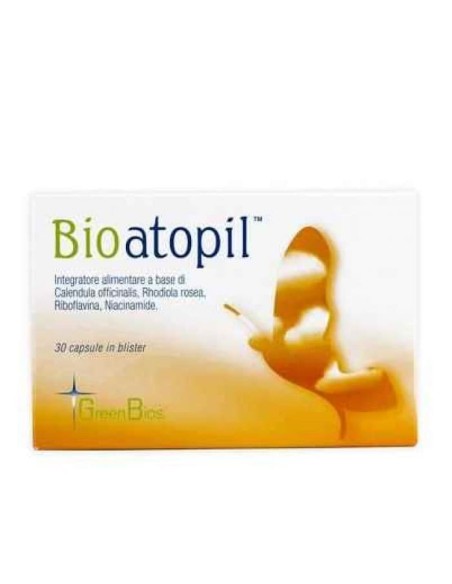
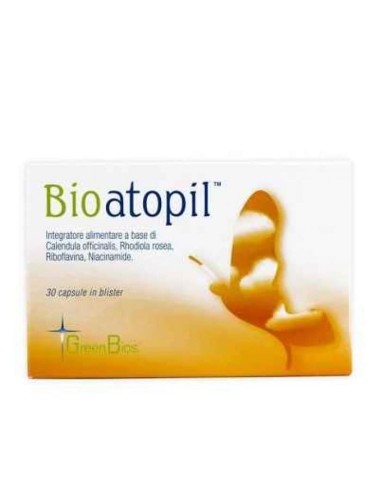
Bioatopil
Description
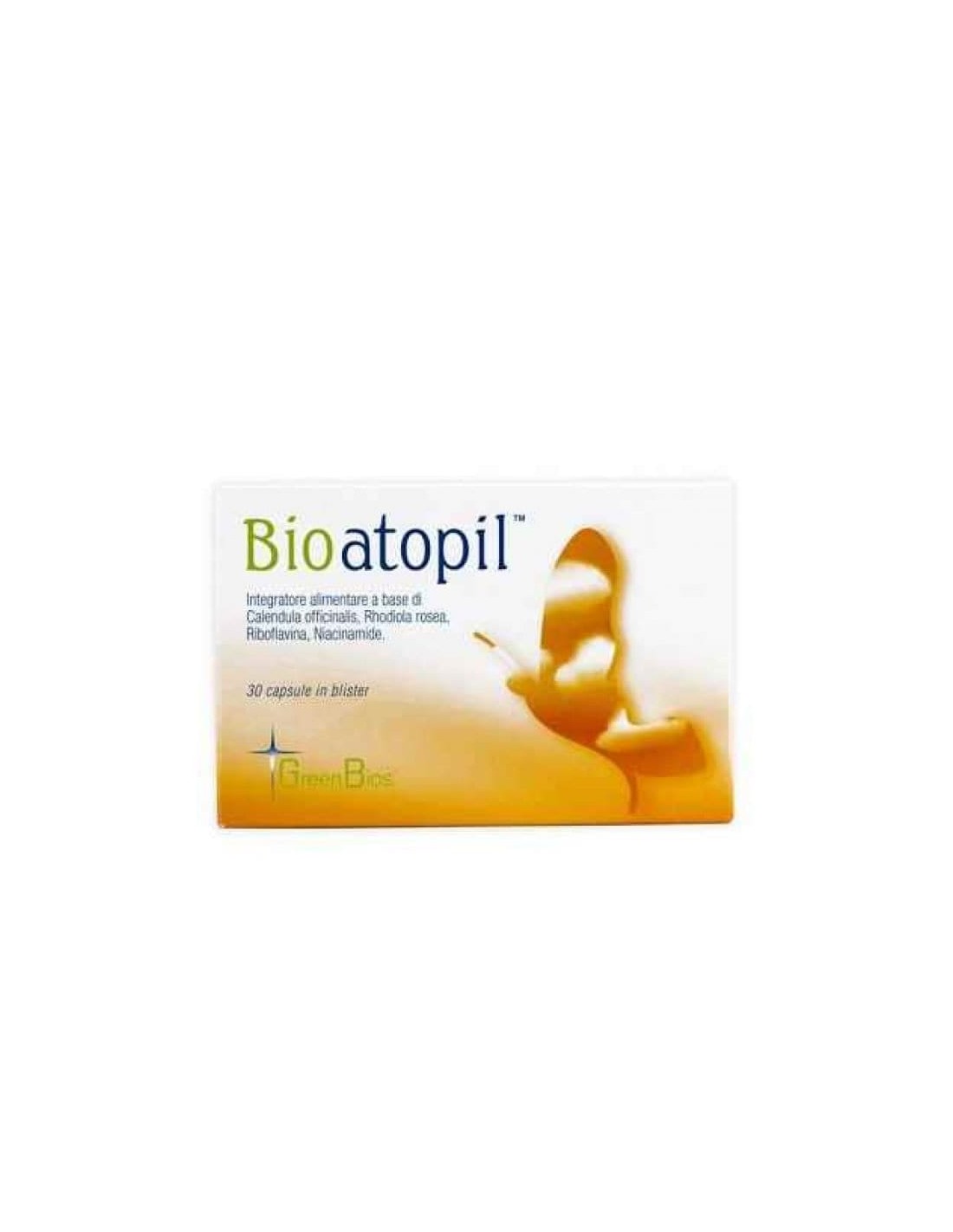
Food supplement based on Calendula officinalis, Rhodiola rosea, riboflavin and niacinamide, able to counter some of the biochemical mechanisms underlying allergies (allergic rhinitis and conjunctivitis, asthma, urticaria, itching in dialysis or due to chronic kidney failure, widespread itching, localised itching, dermatitis and atopic eczema), linked to the uncontrolled production and release of tissue biochemical mediators by mast cells. The antioxidant activity of Rhodiola rosea and the soothing action of calendula further stabilise the production of biochemical mediators, countering the free radicals that damage cells and tissue receptors of the systems affected by inflammation. Taking Bioatopil helps maintain optimal levels of the nutrients needed for the physiological functioning of these complex biochemical systems.
Ingredients
Microcrystalline cellulose; Calendula officinalis flower dry extract 2% lutein; Rhodiola rosea dry extract 1% salidroside; niacinamide; hydroxypropyl methylcellulose E464. Anti-caking agents: vegetable magnesium stearate; amorphous silica; riboflavin; dry extracts on maltodextrins.
Gluten-free and lactose-free.
Directions for use
Allergies, Itching, Urticaria:
- adults: 1 capsule of BIOATOPIL after main meals for three months. Then 1 capsule after main meals for 15 days each month;
- children under 30 kg: 1 capsule a day for 3 months. Then 1 capsule a day for 15 days each month (the capsules can be opened and poured into water or milk);
- children over 30 kg as for adults.
- for body weight over 80 kg it is advisable to take 3 capsules a day.
Prevention of shock from hymenoptera stings:
- adults: 1 capsule after main meals for 4 months. Then 1 capsule after main meals for 15 days a month;
- children under 30 kg: 1 capsule a day for 3 months. Then 1 capsule a day for 15 days each month (the capsules can be opened and poured into water or milk);
- children over 30 kg as for adults;
- for body weight over 80 kg it is advisable to take 3 capsules a day.
Dermatitis and atopic eczema:
- adults: 1 capsule after main meals for 5 months;
Then 1 capsule after main meals for 15 days a month;
- children under 30 kg: 1 capsule a day for 3 months. Then 1 capsule a day for 15 days each month (the capsules can be opened and poured into water or milk);
- children over 30 kg as for adults;
- for body weight over 80 kg it is advisable to take 3 capsules a day.
If itching is intense, start with three capsules a day (morning, midday and evening) for 7-10 days and then continue with two capsules a day. Food allergies:
- adults: for body weight up to 68 kg, 1 capsule after main meals for 12 months. Then 1 capsule after main meals for 15 days each month;
- for body weight over 68 kg, 1 capsule after breakfast, lunch and dinner for 12 months. Then 1 capsule after breakfast, lunch and dinner for 15 days each month.
Warnings
Do not exceed the recommended daily dose.
Keep out of the reach of children under 3 years of age.
Supplements should not be used as a substitute for a varied diet.
Consult a doctor in case of pregnancy or liver or kidney disease.
Breastfeeding women and children should consult a doctor.
Format
Pack of 30 capsules.
Bibliography
- Clin Exp Immunol 2003 Jan;131(1):48-52. Nicotinamide is a potent inhibitor of proinflammatory cytokines. Ungerstedt JS, Blömback M, T Söderström.
- Nucleic Acids J. 2010 Jul 25; Pll: The role of nicotinamide in DNA damage, mutagenesis and DNA repair. Surjana D, GM Halliday, Damian DL.
- J Investig Dermatol Symp Proc. 2006 Sep;126(9):2074-86.Epub 2006 May 11.Serine protease signaling of epidermal permeability barrier homeostasis, Hachem JP, Houben E, Crumrine D, Man MQ, Schurer n, Roelandt T, Choi EH, Uchida Y, Brown BE, Feingold KR, Elias PM.
- J Invest Dermatol Symp Proc.2011 Dec;15(1):16-23. Epidermal proteases in the pathogenesis of rosacea.Meyer-Hoffert U,Scröder JM.
- ISRN Dermatol. 2012; 2012: 759630. Published online 2012 February 1. A Comparative Analysis of Mast Cell Quantification in Five Common Dermatoses: Lichen Simplex Chronicus, Psoriasis, Lichen Planus, Lupus, and Insect Bite/Allergic Contact Dermatitis/Nummular Dermatitis-Nikhil Patel, Amir Mohammadi,* and Ronald Rhatigan- Department of Pathology and Laboratory Medicine, University of Florida College of Medicine-Jacksonville, Jacksonville, FL 32209, USA.