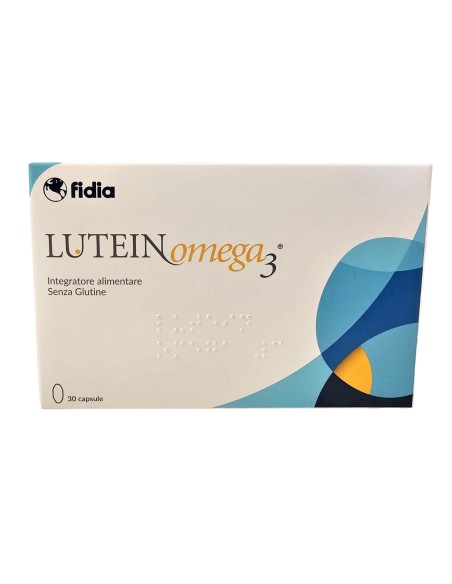
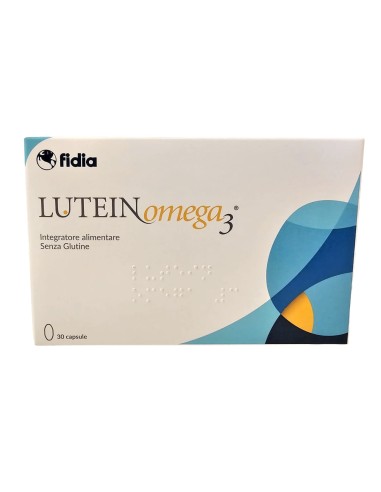
LUTEINomega3
Food supplement consisting of a rational combination of lutein, omega-3 polyunsaturated fatty acids (DHA+EPA), vitamins, zinc and copper. Indicated in cases of increased need for, or reduced dietary intake of, its constituent nutrients. It may be particularly useful in helping to prevent damage to the macula and other sensitive eye structures. Also useful where protection of the vascular and neural components of the eye is required.
Lutein Helps increase contrast sensitivity and, in many cases, improve visual function and reduce photophobia and glare. Thanks to its particular antioxidant activity, the substance has proved useful in protecting the macula from age-related degeneration, in both the atrophic and exudative forms.
Omega-3 fatty acids These are so-called "essential" substances because the body cannot produce them. In the eye they accumulate selectively within the retinal tissue. Omega-3 fatty acids, and in particular docosahexaenoic acid (DHA), are the main components of the phospholipid fraction of the cell membranes of retinal photoreceptors and produce a greater response to light stimuli. Omega-3s help preserve the integrity of the retinal structure and have been described as substances able to play an important role in preserving vision, thanks also to their vasoprotective and neuroprotective effects and a positive influence on the biochemical processes of phototransduction. Recent studies have also shown that increased dietary intake of omega-3 fatty acids is associated with a reduced risk of developing Macular Degeneration, and that the Omega-3/Lutein/Antioxidants combination as an adjuvant in the prevention of retinal disorders is rational.
Vitamin E, Vitamin C These are among the most powerful antioxidants available to the body, safeguarding the integrity of tissues and physiological functional reactions. In synergy with Lutein, they bind and eliminate free radicals, which are mainly responsible for the decline of many delicate tissues following damage to their cell membranes. They help reduce the risk of disorders of the arterial vessels (retina, heart, etc.) and help safeguard the metabolic integrity of eye tissues.
Zinc and Copper These are minerals essential for human health, and recent studies have shown that taking these elements, combined with antioxidants, also significantly reduces the risk of impaired visual function resulting from age-related macular degeneration.
Gluten-free.
Ingredients | | per 1 capsule |
| Lutein | 10 mg |
| Zeaxanthin | 2 mg |
| Omega-3 fatty acids (10%EPA+50%DHA) | 400 mg |
| Vitamin C | 60 mg |
| Vitamin E | 10 mg |
| Copper | 1 mg |
| Zinc | 15 mg |
Directions for use One capsule a day, swallowed with a sip of water.
Warnings Pregnant or breastfeeding women and children should consult a doctor.
Do not exceed the recommended daily dose.
Keep out of the reach of children under three years of age.
Supplements should not be used as a substitute for a varied diet.
Pack size Blister of 30 softgels.
Bibliography - Efficacy of W-3 Fatty Acids in Preventing Age-Related Macular Degeneration. A Systematic Review. Ophthalmology 2006; 113(7): 1165-1173.
- SanGiovanni JP, Chew EY. The role of omega-3 long-chain polyunsaturated fatty acids in health and disease of the retina. Prog Retin Eye Res. 2005 Jan;24(1):87-138. Review.
- Ricardo Uauy, Patricia Mena and Cecilia Rojas. Essential fatty acids in early life: structural and functional role. Proceedings of the Nutrition Society 2000; 59, 3–15.
- Anderson RE, Maude MB, McClellan M, Matthes MT, Yasumura D, LaVail MM Low docosahexaenoic acid levels in rod outer segments of rats with P23H and S334ter rhodopsin mutations. Mol Vis. 2002 Sep 23;8:351-8.
- Alessandri JM, Goustard B, Guesnet P, Durand G, Docosahexaenoic acid concentrations in retinal phospholipids of piglets fed an infant formula enriched with long-chain polyunsaturated fatty acids: effects of egg phospholipids and fish oils with different ratios of eicosapentaenoic acid to docosahexaenoic acid. Am J Clin Nutr 1998: 67: 377-385.
- Wang N, Anderson RE Synthesis of docosahexaenoic acid by retina and retinal pigment epithelium. Biochemistry. 1993 Dec 14;32(49):13703-9.
- Wang N, Anderson RE. Transport of 22:6n-3 in the plasma and uptake into retinal pigment epithelium and retina. Exp Eye Res. 1993 Aug;57(2):225-33.
- Johnson EJ, Schaefer EJ. Potential role of dietary n-3 fatty acids in the prevention of dementia and macular degeneration. Am J Clin Nutr. 2006 Jun;83(6 Suppl):1494S-1498S. Review.
- Chong EW, Sinclair AJ, Guymer RH. Facts on fats. Clin Experiment Ophthalmol. 2006 Jul;34 (5):464-71. Review.
- Cho E et all, Prospective study of dietary fat and the risk of age-related macular degeneration. Am J Clin Nutr 2001; 73: 209-218.
- ARVO 2006 Leung IY et all, Nutritional effects of n-3 fatty acids, lutein and zeaxanthin on the lipofuscin accumulation in the foveal retinal pigment epithelium of rhesus monkeys.
- Nolan JM, et al. (2006) “Monthly consistency of macular pigment optical density and serum concentrations of lutein and zeaxanthin”. Curr Eye Res. 31(2): 199-213.
- Rodriguez-Carmona M, et al. (2006) “The effects of supplementation with lutein and /or zeaxanthin on human macular pigment density and colour vision”. Ophthalmic Physiol Opt 26(2): 137-147.
- Kim SR, Nakanishi K, Itagaki Y, Sparrow JR, (2006) “Photooxidation of A2-PE, a photoreceptor outer segment flourophore, and protection by lutein and zeaxanthin”. Exp Eye Res. 82(5): 828-839.
- Santosa S, Jones P J H, (2005) “Oxidative stress in ocular disease: does lutein play a protective role” CMAJ 173(8):861-862.
- Bernstein PS et all, Resonance Raman measurement of macular carotenoidds in normal subjects and in age-related macular degeneration patients. Ophthalmology 2002; 109(10):1780-7.
- Richer SP et all, The lutein antioxidant supplementation trial (LAST).Optometry 2004; 75 (4):216-30.
- Moeller SM, Parekh N, Tinker L, Ritenbaugh C, Blodi B, Wallace RB, Mares JA; CAREDS Research Study Group. Associations between intermediate age-related macular degeneration and lutein and zeaxanthin in the Carotenoids in Age-related Eye Disease Study (CAREDS): ancillary study of the Women's Health Initiative. Arch Ophthalmol. 2006 Aug;124(8):1151-62.
- Delcourt C, Carriere I, Delage M, Barberger-Gateau P, Schalch W; POLA Study Group. Plasma lutein and zeaxanthin and other carotenoids as modifiable risk factors for age-related maculopathy and cataract: the POLA Study. Invest Ophthalmol Vis Sci. 2006 Jun;47(6):2329-35.