epitech
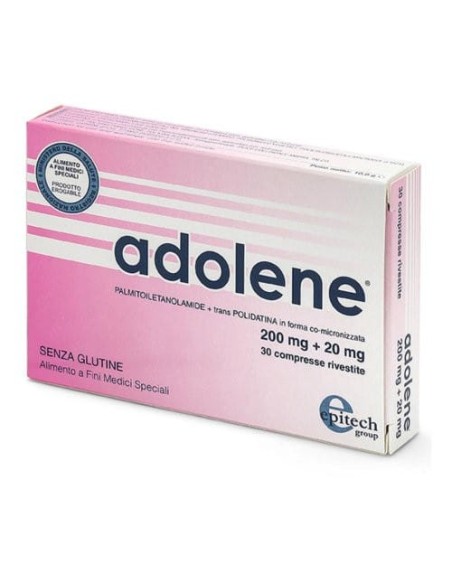
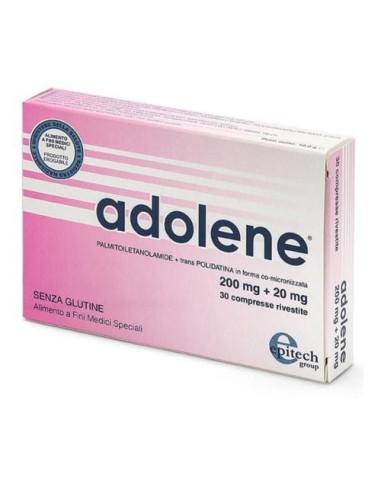
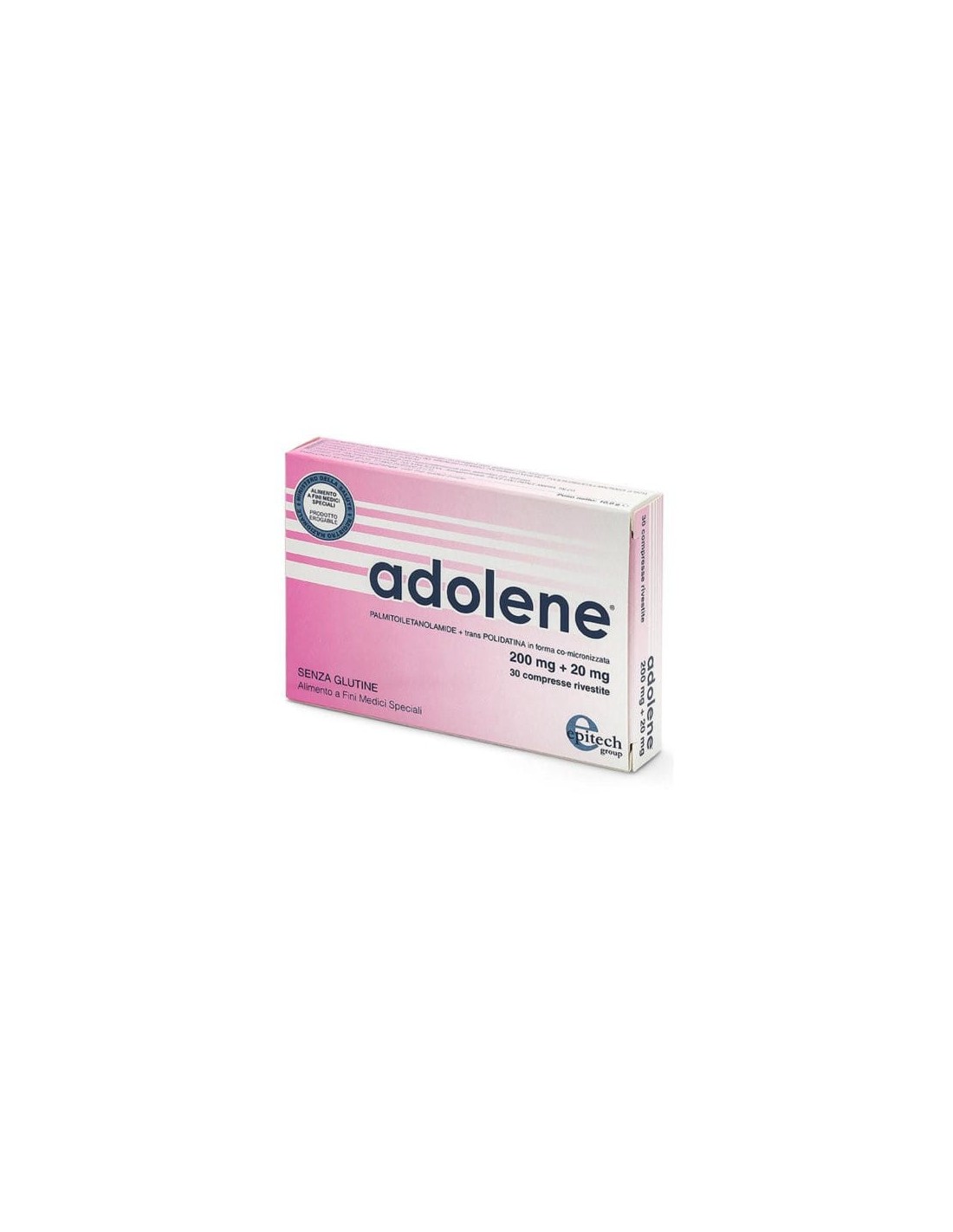
adolene
Micronised PALMITOYLETHANOLAMIDE + trans-POLYDATIN
200 mg + 20 mg
1) PRODUCT NAME
adolene (Food for Special Medical Purposes - FSMP)
2) QUALITATIVE AND QUANTITATIVE COMPOSITION
2.1) Active ingredient: adolene tablets Micronised Palmitoylethanolamide 200 mg + trans-Polydatin 20 mg per tablet.
2.2) Excipients: each adolene 200 mg + 20 mg tablet contains 96.48 mg of a blend of excipients (for the full list see section 7.1).
3) PRODUCT FORM
adolene 200 mg + 20 mg round, pink tablets.
4) CLINICAL INFORMATION
4.1) Indications: Palmitoylethanolamide and trans-Polydatin are nutritional factors that act in the body as synergistic biological modulators, supporting the control of physiological tissue reactivity even in the presence of high oxidative stress. The combination of Palmitoylethanolamide and trans-Polydatin is indicated to counter chronic, inflammatory and painful processes of the pelvic area, a region in which oxidative stress is one of the most important stimuli capable of inducing uncontrolled mast cell degranulation, with consequent tissue hyper-reactivity and the onset of inflammatory processes characterised by hyperalgesia. In such individuals it is useful to physiologically counter the deficit in endogenous production of Palmitoylethanolamide, which occurs when the body, subjected to recurrent inflammatory conditions, exhausts its natural capacity for synthesis, while at the same time modulating the production of regulatory cytokines by T lymphocytes through the presence of trans-Polydatin. adolene is to be used under medical supervision, in the control of the tissue mechanisms that induce and sustain Dysmenorrhoea.
4.2) Dosage and directions for use: as directed by a doctor, as a guide: 2-3 tablets a day for 10 days from day 20 of the menstrual cycle.
4.3) Contraindications: none.
4.4) Warnings and precautions for use: the product is not suitable as the sole source of nutrition. Keep out of the reach of children under 3 years of age.
4.5) Interactions: none identified.
4.6) Pregnancy: administration of the product during pregnancy is not recommended, due to insufficient adequate data on the use of Palmitoylethanolamide and trans-Polydatin in these situations.
4.7) Effects on ability to drive and use machines: the combination of Palmitoylethanolamide and trans-Polydatin, at the recommended doses, does not interfere with the ability to drive or use machines.
4.8) Undesirable effects: no undesirable effects have been reported to date, even after long-term administration and at high doses. No cases of habituation or drug dependence have been reported.
4.9) Overdose: no clinical cases of overdose are known to date.
5) PROPERTIES
5.1) Category: Food for Special Medical Purposes.
5.2) Biodynamic properties: Palmitoylethanolamide is an endogenous N-acylethanolamide, chemically similar to the endocannabinoid anandamide and with a largely shared spectrum of biological activity. The main difference between the two molecules is the inability of Palmitoylethanolamide to interact with the CB1 receptor responsible for the psychotropic effects of the endocannabinoid; its intake is therefore not associated with these central effects. Palmitoylethanolamide has anti-inflammatory effects, affecting both peripheral inflammatory processes and central neuroinflammation, and analgesic effects, evident in both acute and chronic-neuropathic pain, highlighted by numerous experimental in vitro and in vivo studies and by a growing number of clinical studies. trans-Polydatin (or Piceid) is a glucoside of Resveratrol, a trihydroxystilbene polyphenol. It has marked antioxidant activity both as a scavenger and as an inhibitor of lipid peroxidation. It has also been shown to control cellular oxidative processes that play an important role in the development of disorders of the Pelvic System.
5.3) Biokinetic properties: after oral administration in humans of single doses between 300 and 1200 mg, Palmitoylethanolamide is present in plasma at dose-dependent concentrations. The plasma peak of Palmitoylethanolamide is observed one hour after intake; plasma levels then begin to decrease and return to baseline within six hours. Experimental studies have shown that after oral administration Palmitoylethanolamide is evenly distributed in the tissues. After oral administration of trans-Polydatin, concentrations of glucuronides similar to those found after administration of trans-Resveratrol have been identified and quantified in the blood. These metabolites disappear from plasma within 24 hours of intake.
5.4) Mechanisms of action: several mechanisms of action of Palmitoylethanolamide in different pathological conditions have been described. Two main cellular targets of the molecule are known: the mast cell and microglia. Normalisation of the excessive activation of these immunocompetent cells involved in peripheral inflammatory processes, central neuroinflammation and acute and chronic-neuropathic pain is responsible for the main effects of Palmitoylethanolamide. At the molecular level, Palmitoylethanolamide interacts with multiple receptors, the main one being the nuclear receptor PPAR-α, a receptor involved in the control of inflammatory and neuroprotective processes. Under certain conditions, Palmitoylethanolamide interacts with the cannabinoid receptor CB2, a receptor found mainly on immune cells, including mast cells and microglia, whose expression increases markedly in inflammatory conditions. Palmitoylethanolamide enhances the activity of endogenous N-acylethanolamides. This mechanism, known as the entourage effect, allows Palmitoylethanolamide to interact indirectly with the endocannabinoid and endovanilloid systems. In addition to its strong antioxidant properties, trans-Polydatin exerts an anti-inflammatory activity related to its ability to modulate the functions of various immunocompetent cells such as T lymphocytes, specifically by regulating their production of regulatory and pro-inflammatory cytokines. At low concentrations it can stimulate an immune response, while at higher concentrations it inhibits it.
5.5) Clinical efficacy: Palmitoylethanolamide and trans-Polydatin are molecules with synergistic effects on cells (mast cells and lymphocytes) that are strongly involved in inflammatory processes and capable of triggering mutual activation. Their combination has been shown to be a valid therapeutic intervention targeting chronic, inflammatory and painful processes of the pelvic system.
6) TOXICOLOGY AND TOLERABILITY
Toxicology studies have shown that the LD50 of Palmitoylethanolamide administered by injection (intraperitoneal) in dogs is greater than 400 mg/kg and in rats, after a single administration by gastric tube, exceeds 5000 mg/kg, while after repeated administration, also by gastric tube, it exceeds 500 mg/kg/day. Clinical studies carried out with adolene on a considerable number of patients demonstrate the excellent tolerability of the Palmitoylethanolamide + trans-Polydatin combination even at very high doses, and the absence of clinically relevant changes in the haematological and blood chemistry tests performed.
6.1) Embryotoxicity: no teratogenic or embryotoxic effect of Palmitoylethanolamide was observed after administration during pregnancy of 50 mg/kg body weight for 12 days. In addition, newborns of mothers receiving PEA before delivery were more resistant to Shigella Shigae toxin up to 10 days after birth. Similarly, newborns of mothers receiving PEA before delivery showed increasing resistance already evident 5 days after birth: these data suggest that mothers may have transferred PEA to newborns through milk. No embryotoxic effects of trans-Polydatin are known.
6.2) Mutagenicity: although a potential mutagenic effect of Palmitoylethanolamide can be ruled out as it is already present in the mammalian body, the mutagenicity of PEA was verified using the Ames test, with 5 mutant strains of S. typhimurium (TA 1535-TA1537-TA1538-TA98 and TA 100). In the Ames test, Palmitoylethanolamide, used at doses between 10000 and 1000 mcg/ml, did not significantly change the number of revertants. No mutagenic effects of trans-Polydatin are known.
6.3) Gastric tolerability: oral administration of Palmitoylethanolamide at a dose of 50 mg/kg (approximately 5 times higher than the active dose), and at a dose of 10 mg/kg in repeated administrations for 5 days, does not induce ulcer formation.
Furthermore, when administered at a dose of 50 mg/kg together with diclofenac 15 mg/kg, a dose known to induce gastric lesions, PEA reduces the ulcerogenic potential of NSAIDs, lowering the number of animals developing ulcerations and mitigating any damage.
7) PRODUCT INFORMATION
7.1) Excipients: adolene 200 mg + 20 mg tablets contain 96.48 mg of a blend of excipients (Microcrystalline cellulose, Magnesium stearate, Vegetable polysorbate, Croscarmellose sodium, Polyvinylpyrrolidone, Colloidal anhydrous silica, Polyvinyl alcohol) and are coated with a film consisting in total of 9.5 mg of E120, E1521, E171
7.2) Incompatibilities: none known.
7.3) Shelf life: 3 years.
7.4) Special precautions for storage: this product does not require any special storage conditions.
7.5) Nature and contents of container: PVC/PVDC/aluminium foil blisters in boxes of 30 tablets.
7.6) Special precautions for disposal: no special instructions.
7.7) Gluten: this product does not contain gluten.
8) MARKETING AUTHORISATION HOLDER
EPITECH Group SpA – via Egadi, 7 – 20144 Milano – Italia
9) MARKETING AUTHORISATION NUMBER
adolene 200 mg + 20 mg tablets DGSAN 0011257-P
10) DATE OF FIRST MARKETING AUTHORISATION
adolene 200 mg + 20 mg tablets 22/04/2008
11) DATE OF REVISION OF THE TEXT 04/2014