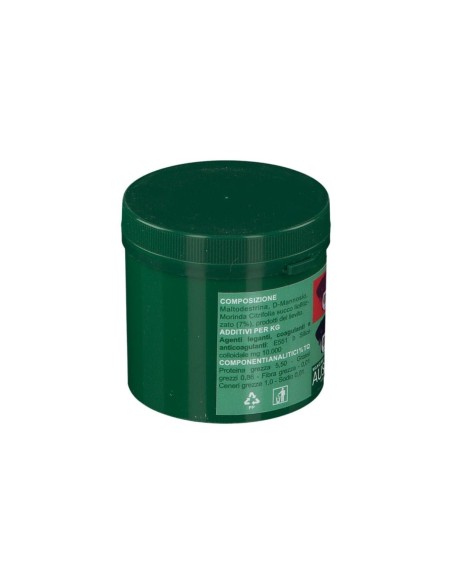
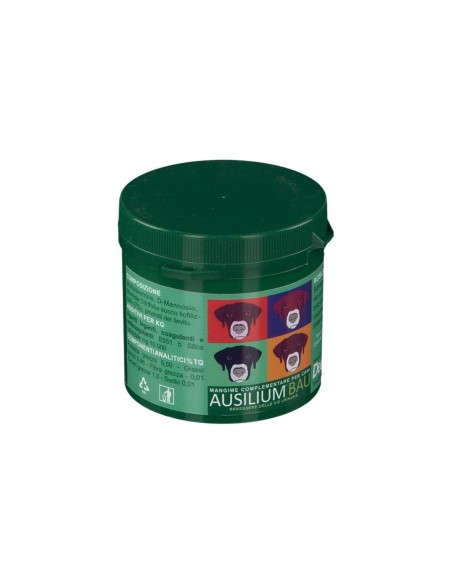
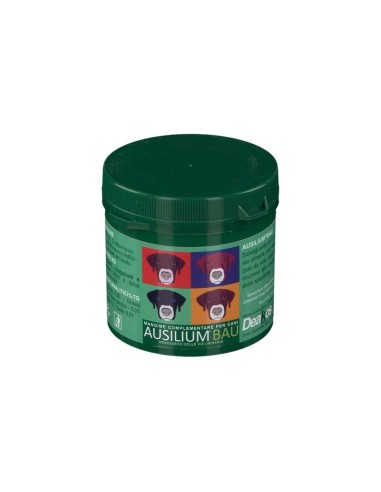
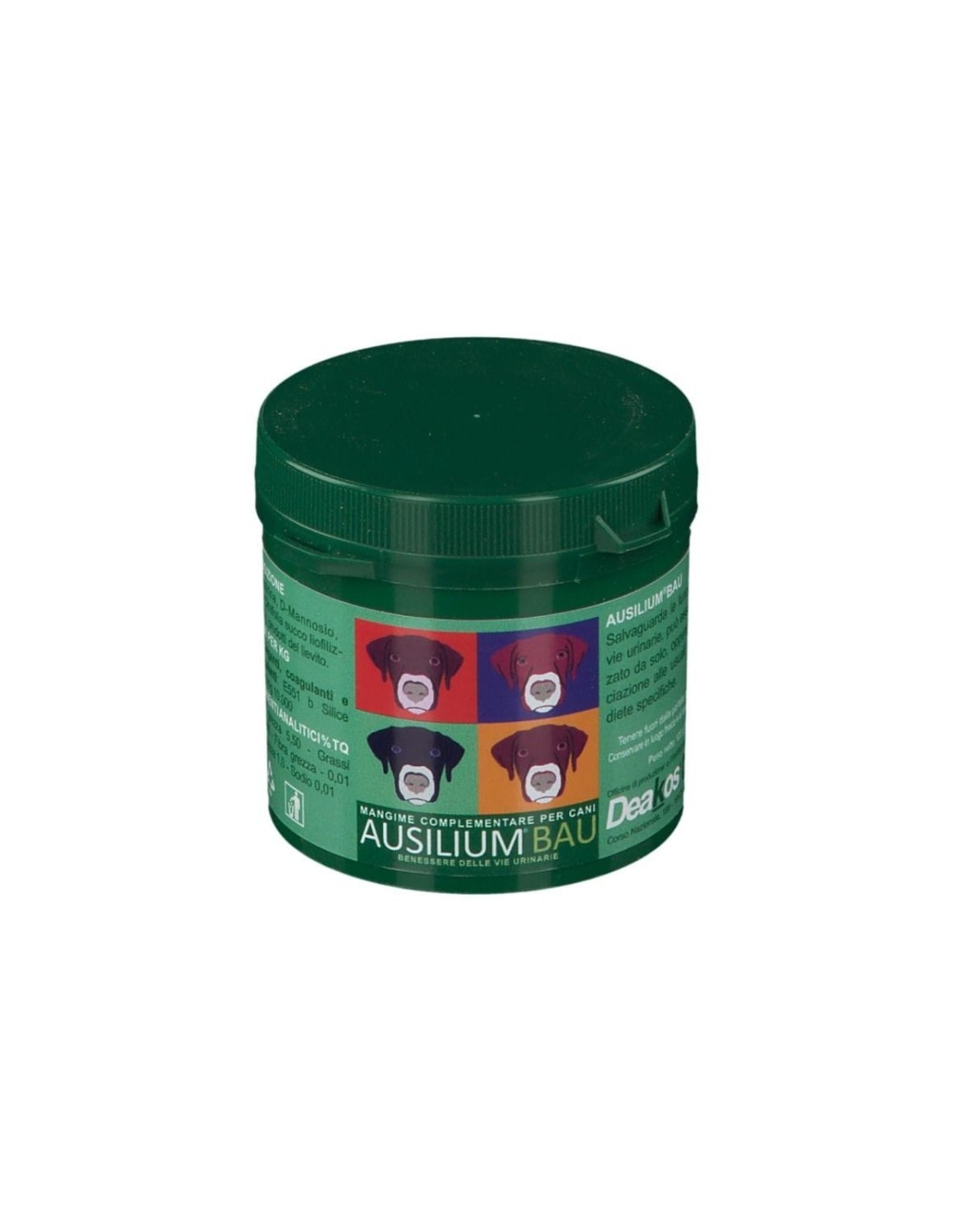
AUSILIUM BAU
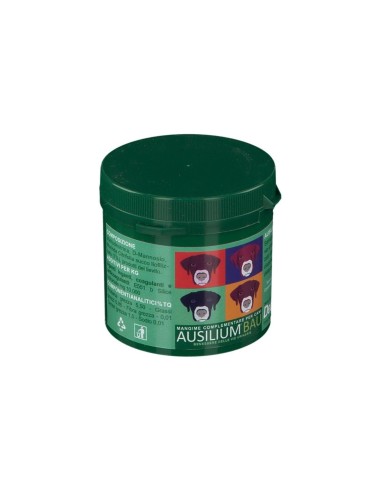
Complementary powdered feed for dogs that helps protect the urinary tract.
Indicated as a complementary aid in cystitis and other urinary tract infections, it may be particularly useful in case of Escherichia coli, Klebsiella, Enterococcus faecalis, Streptococcus, Staphylococcus, Proteus, Pseudomonas and other fimbriated bacteria. Unlike antibiotic therapy, the bacteria are not killed but eliminated mechanically, carried out with the flow of urine. This avoids damaging the physiological bacterial flora, a precious ally of the animal's health.
AUSILIUM BAU can be given both during acute phases (in combination with specific treatments prescribed by the vet) and in recurrent or relapsing forms (alone or in combination with specific diets recommended by the vet). It can also be used for prevention and maintenance.
Ingredients
Maltodextrin, Pork liver meal, D-Mannose.
Botanically defined natural products: Morinda citrifolia L. extract 70.000 mg.
Directions for use
Mix the powder into the usual ration of wet food according to the following daily dosage:
- up to 10 kg body weight: 2 scoops a day, in two administrations, for a total of 3 g;
- from 10 to 20 kg body weight: 4 scoops a day, in two administrations, for a total of 6 g;
- over 20 kg body weight: 6 scoops a day, in two administrations, for a total of 9 g.
For prevention and maintenance, half the dose is sufficient.
If feeding exclusively dry food, moisten the food slightly so that the powder adheres well and is fully eaten.
A 10-15 day course is recommended, which may be repeated at the vet's discretion.
Warnings
For veterinary use only. Keep out of the reach of children.
Storage
Store in a dry place, away from light.
Pack size
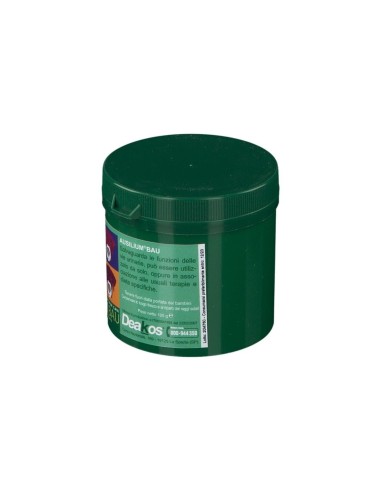
100 g pack.
Code PT267
Bibliography:
1. Abgottspon D, Rabbani S, Herold J, Jiang X, Ernst B. FimH antagonists for the oral treatment of urinary tract infection: from design and synthesis to in vitro and in vivo evaluation. Klein J Med Chem Dec 2010;53:8627-41.
2. Akihisa T, Matsumoto K, Tokuda H. Anti-inflmmatory and potential cancer chemopreventive constituents of the fruits of Morinda citrifolia (Noni). J Nat Prod 2007;70:754-7.
3. Alitheen NB, Manaf AA, Yeap SK. Immunomodularory effects of Damnacanthal isolated from roots of Morinda elliptica. Pharm Biol 2010;48:446-52.
4. Altarac S, Papes D. Use of d-mannose in prophylaxis of recurrent urinary tract infections (UTIs) in women. BJU Int 2014;113:9-10.
5. American Chemical Society. Noni plant may yield new drugs to fiht tuberculosis. Press Releas at the 2000 International Chemical Congress of Pacifi Basin Societies.
6. Crepin S, Houle S, Carbanneau ME', Mourez M, Harel J, Dozois CM. Decreased expression of type 1 fibriae by a pst mutant of uropathogenic Escherichia urinary tract infection: contribution to intracellular biofilm development. Virulence 2010;1:333-7.
7. Cusumano CK, Pinkner JS, Han Z, Handerson JP, Croweley JR, Hultgren SJ. Treatment and prevention of urinary tract infection with orally active FimH inhibitors. Sci Transl Med Nov 2011;3:109-15.
8. Gupta RK, Banerjee A, Pathak S. Induction of mitochondrial-mediated apoptosis by Morinda citrifolia (Noni) in human cervical cancer cells. Asian Pac J Cancer Prev 2013;14:237-42.
9. Gupta RK, Patel AK. Do the health claims made for Morinda citrifolia (Noni) harmonize with current scientifi knowledge and evaluation of its biological effects. Asian Pac J Canc Prev 2013;14:147-49.
10. Heinicke R. The Xeronine system: a new cellular mechanism that explains the health promoting action of NONI and Bromelian. Direct Source Pub 2001.
11. Jiang X, Abgottspon D, Kleeb S, Rabbani S, Scharenberg M, Wittwer M et al. Antiadhesion therapy for urinary tract infections--a balanced PK/PD profie proved to be key for success. J Med Chem 2012;55:4700-13.
12. Kranjcec B, Papes D, Altarac S. D-mannose powder for prophylaxis of recurrent urinary tract infections in women: a randomized clinical trial. World J Urol 2013;32:79-84.
13. Nava CM, Ricciardo G, Valieri M. Trattamento e prevenzione delle recidive delle vaginiti. Medicinae Doctor 2013 numero 8.
14. Pawlus AD, Su BN, Keller WJ. An anthraquinone with potent quinone reductase-inducing activity and other constituents of the fruits of Morinda citrifolia (Noni). J Nat Prod 2005;68:1720-2.
15. Porru D, Parmigiani A, Tinelli C, Barletta D, Choussos D, Di Franco C, Bobbi V, Bassi S, Miller O, Gardella B, Nappi RE, Spinillo A and Rovereto B. Oral D-mannose in recurrent urinary tract infections in women: A pilot study. J Clin Urol 2014; 20 (10) 1–6.
16. Pratt LA, Kolter R. Genetic analysis of Escherichia coli biofilm formation: roles of flagellar motility, chemotaxis and type 1 pili. Mol Microbiol 1998;30:285-93.
17. Reid G, Sobel JD. Bacterial adherence in the pathogenesis of urinary tract infection: a review. Clin Infect Dis 1987;9:470-87.
18. Sharon N. Carbohydrates as future anti-adhesion drugs for infectious diseases. Biochim Biophys Acta 2006;1760:527-37.
19. Umezawa K. Isolation of 1-methoxy-2-foremyl3-hydroxyanthraquinone from M citrifolia and neoplasminhibitors containing the same. Japan Kokai Tokyo Koho JP 1992;87:736(94-87, 736).
20. Wellens A, Garofalo C, Nguyen H, Van Gerven N, Bouckaert J. Intervening with urinary tract infections using anti-adhesives based on crystal structure of the FimH-ologomannose-3 complex. PLoS one 2008;3:e2040.