Name
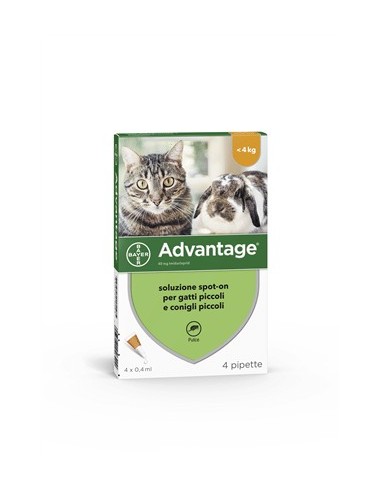
ADVANTAGE 40 MG SPOT-ON SOLUTION FOR SMALL CATS AND SMALL RABBITS
Pharmacotherapeutic category
Ectoparasiticide for topical use; imidacloprid.
Active ingredients
Each 0.4 ml pipette contains active substance: imidacloprid 40 mg. Excipient(s): butylated hydroxytoluene (E 321) 0.4 mg; benzyl alcohol (E 1519) 332.8 mg. For the full list of excipients, see section 6.1.
Excipients
Butylated hydroxytoluene (E 321), benzyl alcohol (E 1519), propylene carbonate.
Indications
For cats under 4 kg: prevention and treatment of flea infestations (Ctenocephalides felis). For rabbits under 4 kg: treatment of flea infestations. Fleas are killed within one day of treatment. One treatment prevents further flea infestation for 3-4 weeks in cats and for up to one week in rabbits. In cats, the veterinary medicine can be used as part of a treatment strategy for the control of Flea Allergy Dermatitis (FAD), where this has been previously diagnosed by a veterinary surgeon.
Contraindications/Undesirable effects
Do not treat unweaned kittens under 8 weeks of age. Do not use on rabbits under 10 weeks of age. Do not use in cases of hypersensitivity to the active substance or to any of the excipients.
Safety in the target species
In cats, no adverse clinical signs were seen at five times the therapeutic dose, given weekly for eight consecutive weeks. In rabbits, no adverse clinical signs were observed at doses up to 45 mg/kg body weight (4 times the therapeutic dose), given weekly for 4 consecutive weeks. In rare cases of overdose or if the animal licks the treated fur, nervous system disorders (such as twitching, tremors, ataxia, mydriasis, miosis, lethargy) may occur in cats. Poisoning following accidental oral ingestion is unlikely in animals. Should it occur, treatment should be symptomatic under veterinary supervision. There are no known specific antidotes, but administration of activated charcoal may be beneficial.
Dosage
This veterinary medicine is for topical use and must not be given orally. Animals should be weighed accurately before treatment. Dosage and dosing schedule. Cat/rabbit (kg bw): < 4 kg; product: advantage 40 for small cats and small rabbits; number of pipettes: 1 × 0.4 ml; imidacloprid (mg/kg bw): minimum 10. Method of administration: remove one pipette from the pack. Holding the pipette upright, twist and remove the cap. Use the reversed cap to twist and remove the seal from the pipette. Administration in cats: part the fur on the cat's neck at the base of the skull until the skin is visible. Place the tip of the pipette on the skin and squeeze firmly several times to empty the entire contents directly onto the skin. Administration in rabbits: part the fur on the rabbit's neck at the base of the skull until the skin is visible. Place the tip of the pipette on the skin and squeeze firmly several times to empty the entire contents directly onto the skin.
Storage
This veterinary medicine does not require any special storage conditions. Keep the blister in the outer carton. Shelf life of the veterinary medicine as packaged for sale: 5 years.
Warnings
Re-infestation from the emergence of new fleas in the environment may continue to occur for six weeks or longer after treatment is started. More than one treatment may therefore be required, depending on the level of fleas in the environment. To help reduce environmental infestation, the additional use of a suitable environmental treatment against adult fleas and their developmental stages is recommended. To further reduce environmental infestation, treatment of all cats and rabbits in the household is recommended. Treating lactating queens and does controls flea infestations on both the mother and her offspring. The veterinary medicine remains effective if the animal gets wet, for example after exposure to heavy rain. However, depending on the presence of fleas in the environment, further treatment may be necessary. In such cases do not treat more often than once a week. Special precautions for use in animals: this veterinary medicine is for topical use and must not be given orally. Apply only to undamaged skin. Care should be taken to prevent the contents of the pipette from coming into contact with the eyes or mouth of the treated animal. Do not allow recently treated animals to groom each other. Any collar should be removed before applying the product. Before refitting the collar, the treated area should be checked visually to make sure it is dry. Special precautions to be taken by the person administering the veterinary medicine to animals: people with known hypersensitivity to imidacloprid should avoid contact with the veterinary medicine. This product contains benzyl alcohol and in rare cases may cause skin sensitisation or transient skin reactions (e.g. irritation, tingling). Avoid contact between the product and the skin, eyes or mouth. Do not massage the application site. Do not eat, drink or smoke during application. Wash any skin contamination with soap and water. If the product gets into the eyes, rinse them thoroughly with water. If skin or eye irritation persists, seek medical advice. If the product is accidentally swallowed, consult a doctor immediately. After application, do not stroke or groom animals until the application site is dry. Wash hands thoroughly after use. Other precautions: the solvent in this veterinary medicine may stain certain materials including leather, fabrics, plastics and polished surfaces. Allow the application site to dry before permitting contact with such materials. In cats, no adverse clinical signs were seen at five times the therapeutic dose, given weekly for eight consecutive weeks. In rabbits, no adverse clinical signs were observed at doses up to 45 mg/kg body weight (4 times the therapeutic dose), given weekly for 4 consecutive weeks. In rare cases of overdose or if the animal licks the treated fur, nervous system disorders (such as twitching, tremors, ataxia, mydriasis, miosis, lethargy) may occur in cats. Poisoning following accidental oral ingestion is unlikely in animals. Should it occur, treatment should be symptomatic under veterinary supervision. There are no known specific antidotes, but administration of activated charcoal may be beneficial. Major incompatibilities: none known.
Withdrawal periods
Do not use on rabbits intended for human consumption.
Target species
Cats and rabbits.
Interactions
No incompatibility has been observed between this veterinary medicine, at twice the recommended dose, and the following commonly used veterinary medicines: lufenuron, pyrantel and praziquantel (cats). The compatibility of the veterinary medicine has also been demonstrated with a wide range of routine treatments under field conditions, including vaccination.
Diagnosis and prescription
Sale is not restricted exclusively to pharmacies and does not require a veterinary prescription.
Undesirable effects
The veterinary medicine has a bitter taste and salivation may occasionally occur if the animal licks the application site immediately after treatment. This is not a sign of intoxication and disappears within a few minutes without treatment. On very rare occasions (fewer than 1 animal in 10,000 treated, including isolated reports), skin reactions such as hair loss, redness, itching and skin lesions may occur in cats and rabbits. In cats, agitation, excessive salivation and nervous signs such as incoordination, tremors and depression have also been observed, albeit in exceptional cases. Oral ingestion may cause other gastrointestinal signs (vomiting and diarrhoea), which have been observed very rarely according to post-marketing data. Oral ingestion may cause other gastrointestinal signs (vomiting and diarrhoea), which have been observed very rarely according to post-marketing data. The frequency of adverse reactions is defined using the following convention: very common (more than 1 in 10 treated animals displaying adverse reactions); common (more than 1 but fewer than 10 animals in 100 treated animals); uncommon (more than 1 but fewer than 10 animals in 1,000 treated animals); rare (more than 1 but fewer than 10 animals in 10,000 treated animals); very rare (fewer than 1 animal in 10,000 treated animals, including isolated reports).
Pregnancy and lactation
No toxic effects on reproduction were observed in rats, and no primary embryotoxicity or teratogenic toxic effects were observed in studies in rats and rabbits. Studies in pregnant and lactating queens and their offspring are limited. Evidence to date suggests that no adverse effects are to be expected in these animals.