Name
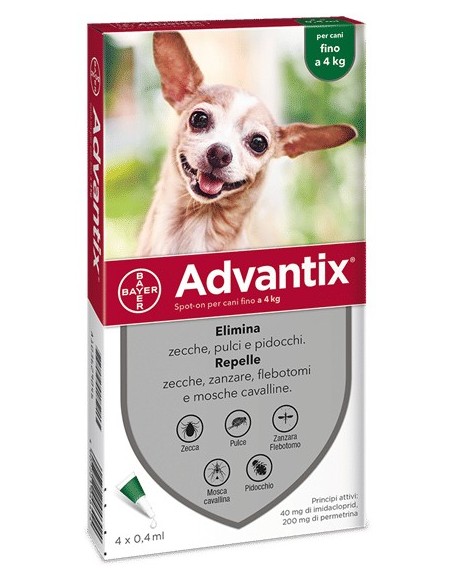
ADVANTIX SPOT-ON FOR DOGS UP TO 4 KG
Pharmacotherapeutic group
Ectoparasiticides, insecticides and repellents.
Active substances
Each 0.4 ml pipette contains imidacloprid: 40.0 mg. Permethrin (40/60): 200.0 mg. Excipient(s): butylhydroxytoluene (E321): 0.4 mg. For the full list of excipients, see section 6.1.
Excipients
Butylhydroxytoluene (E321), N-methylpyrrolidone, Miglyol 812, citric acid (E330).
Indications
For the treatment and prevention of flea infestations (Ctenocephalides canis, Ctenocephalides felis). Fleas on dogs are killed within one day of treatment. One treatment prevents further flea infestation for four weeks. The product can be used as part of a treatment strategy for flea allergy dermatitis (FAD). For the treatment of lice (Trichodectes canis). The product has persistent acaricidal and repellent efficacy against tick infestations (Rhipicephalus sanguineus and Ixodes ricinus for four weeks, and Dermacentor reticulatus for three weeks). Through its repellent and killing action on the vector tick Rhipicephalus sanguineus, the product reduces the likelihood of transmission of the pathogen Ehrlichia canis, thereby reducing the risk of canine ehrlichiosis. The reduction in risk has been shown in studies from day 3 after application of the product and persists for 4 weeks. Ticks already on the dog may not be killed within two days of treatment and may remain attached and visible. Removal of ticks already on the dog at the time of treatment is therefore recommended, to prevent them from attaching and taking a blood meal. One treatment provides repellent (anti-feeding) activity against sand flies (Phlebotomus papatasi for two weeks and Phlebotomus perniciosus for three weeks), against mosquitoes (Aedes aegypti for two weeks and Culex pipiens for four weeks) and against stable flies (Stomoxys calcitrans) for four weeks. Reduction in the risk of infection with Leishmania infantum via transmission by sand flies (Phlebotomus perniciosus) for up to 3 weeks. The effect is indirect, due to the product's activity against the vector.
Contraindications/Undesirable effects
In the absence of available data, the product should not be used on puppies under 7 weeks of age or weighing less than 1.5 kg. Do not use in case of hypersensitivity to the active substances or to any of the excipients. Do not use on cats (see section 4.5 - Special precautions for use)
Safety in the target species
No adverse clinical signs were noted in healthy puppies or adult dogs exposed to a 5x overdose, or in puppies whose mothers had been treated with a 3x overdose of the product.
Dosage
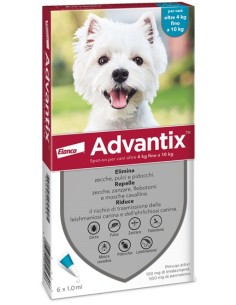
The minimum recommended dose is: 10 mg/kg body weight (bw) of imidacloprid and 50 mg/kg body weight (bw) of permethrin. Dosage schedule for Advantix Spot-on. Dogs (kg body weight): <= 4 kg; trade name: Advantix spot-on for dogs up to 4 kg; volume: 0.4 ml; imidacloprid: minimum 10 mg/kg body weight; permethrin: minimum 50 mg/kg body weight. Dogs (kg body weight): >4 kg <= 10 kg; trade name: Advantix spot-on for dogs over 4 kg up to 10 kg; volume: 1.0 ml; imidacloprid: 10 - 25 mg/kg body weight; permethrin: 50 - 125 mg/kg body weight. Dogs (kg body weight): >10 kg <= 25 kg; trade name: Advantix spot-on for dogs over 10 kg up to 25 kg; volume: 2.5 ml; imidacloprid: 10 - 25 mg/kg body weight; permethrin: 50 - 125 mg/kg body weight. Dogs (kg body weight): >25 kg <= 40 kg; trade name: Advantix spot-on for dogs over 25 kg up to 40 kg; volume: 4.0 ml; imidacloprid: 10 - 16 mg/kg body weight; permethrin: 50 - 80 mg/kg body weight. To reduce reinfestation from the emergence of new fleas, it is recommended that all dogs in the household are treated. Other animals living in the same household should be treated with a suitable product. To further help reduce the environmental challenge, the additional use of a suitable environmental treatment against adult fleas and their developing stages is recommended. The product remains effective if the animal gets wet. However, intense and prolonged exposure to water should be avoided. In case of frequent exposure to water, the persistence of efficacy may be reduced. In such cases do not re-treat more frequently than once a week. If the dog needs a shampoo, it is best to do so before applying Advantix or at least two weeks after application, to optimise the efficacy of the product. In case of lice infestation, a further veterinary examination 30 days after treatment is recommended, as some animals may require a second treatment. To protect a dog throughout the whole sand fly season, treatment should be continued consistently throughout. For spot-on use only. Apply only to undamaged skin. Method of administration for pipettes with a short applicator tip: remove one pipette from the pack. Holding the pipette upright, twist and remove the cap. Turn the cap round and place the other end back on the pipette. Twist the cap to break the seal, then remove the cap from the pipette. For dogs of 10 kg body weight or less: with the dog standing still, part the coat between the shoulder blades until the skin is visible. Place the tip of the pipette on the skin and squeeze firmly several times to empty the contents directly onto the skin. For dogs over 10 kg body weight: with the dog standing still, the entire contents of the Advantix pipette should be applied evenly to four spots on the top of the back from the shoulders to the base of the tail. At each spot, part the coat until the skin is visible. Place the tip of the pipette on the skin and squeeze gently to expel a portion of the solution onto the skin. Do not apply an excessive amount of solution at any one spot, which could cause some of it to run down the side of the dog. Method of administration for pipettes with a long applicator tip: remove one pipette from the pack. Holding the pipette upright, twist and remove the cap. For dogs of 10 kg body weight or less: with the dog standing still, part the coat between the shoulder blades until the skin is visible. Place the tip of the pipette on the skin and squeeze firmly several times to empty the contents directly onto the skin. For dogs over 10 kg body weight: with the dog standing still, the entire contents of the Advantix pipette should be applied evenly to four spots on the top of the back from the shoulders to the base of the tail. At each spot, part the coat until the skin is visible. Place the tip of the pipette on the skin and squeeze gently to expel a portion of the solution onto the skin. Do not apply an excessive amount of solution at any one spot, which could cause some of it to run down the side of the dog.
Storage
Do not freeze. Pipette with short applicator tip: after opening the aluminium pouch, store in a dry place at a temperature not exceeding 30 °C. Pipette with long applicator tip: after opening the aluminium pouch, the product must be applied to the dog's skin. Pipette with short applicator tip (pipettes in blister in the pouch). Shelf life of the veterinary medicinal product as packaged in the aluminium pouch: 5 years. Shelf life after opening the aluminium pouch: 2 years (all pipettes must be used within 2 years of opening the aluminium pouch or before the expiry date on the pipette, whichever is sooner). Shelf life of the opened pipette: not applicable. Once opened, the entire contents of the pipette must be applied to the animal's skin. Pipette with long applicator tip (in individual pouches). Shelf life of the product in the aluminium pouch: 3 years. Shelf life of the opened pipette: not applicable. Once opened, the entire contents of the pipette must be applied to the dog's skin.
Warnings
Individual ticks may attach or individual sand flies or mosquitoes may bite. For this reason, if conditions are unfavourable, transmission of infectious diseases by these parasites cannot be completely ruled out. It is recommended to apply the treatment at least 3 days before expected exposure to E. canis. With regard to E. canis, studies have shown a reduced risk of canine ehrlichiosis in dogs exposed to Rhipicephalus sanguineus ticks infected with E. canis from 3 days after application of the product, persisting for 4 weeks. Immediate protection against sand fly bites is not documented. Dogs treated to reduce the risk of infection with Leishmania infantum via transmission by P. perniciosus sand flies should be kept in a protected environment during the first 24 hours after the initial treatment. i) Special precautions for use in animals: care should be taken to prevent the contents of the pipette from coming into contact with the eyes or mouth of the treated dogs. Care should be taken to administer the product correctly as described in section 4.9. In particular, oral intake due to licking of the application site by treated animals or by animals in contact with them should be prevented. Do not use on cats. This product is extremely poisonous to cats and could be fatal, due to the unique physiology of cats, which are unable to metabolise certain compounds, including permethrin. To prevent cats from being accidentally exposed to the product, keep treated dogs away from cats after treatment until the application site is dry. It is important to make sure that cats do not lick the application site of a dog treated with this product. If this occurs, seek veterinary advice immediately. Consult your veterinary surgeon before using the product on sick and debilitated dogs. ii) Special precautions to be taken by the person administering the veterinary medicinal product to animals: avoid contact of the product with the skin, eyes or mouth. Do not eat, drink or smoke during application. Wash hands thoroughly after use. In case of accidental spillage onto the skin, wash off immediately with soap and water. People with known skin sensitivity may be particularly sensitive to this product. The predominant clinical symptoms which in extremely rare cases may occur are transient sensory irritation of the skin such as tingling, burning sensation or numbness. If the product accidentally gets into the eyes, they should be rinsed thoroughly with water. If skin or eye irritation persists, seek medical advice immediately and show the doctor the package leaflet. Do not swallow. In case of accidental ingestion, seek medical advice immediately and show the package leaflet or the label to the doctor. Treated dogs should not be handled, especially by children, until the application site is dry. This can be ensured, for example, by treating dogs in the evening. Recently treated dogs should not be allowed to sleep with their owners, especially children. To prevent children from getting access to pipettes, keep the pipettes in the original packaging until use and dispose of used pipettes immediately. iii) Other precautions: as the product is dangerous to aquatic organisms, treated dogs should not under any circumstances be allowed to enter any type of surface water for at least 48 hours after treatment. The solvent in Advantix Spot-on may stain certain materials including leather, fabrics, plastics and polished surfaces. Allow the application site to dry before permitting contact with such materials. No adverse clinical signs were noted in healthy puppies or adult dogs exposed to a 5x overdose, or in puppies whose mothers had been treated with a 3x overdose of the product. Incompatibilities: none known.
Withdrawal period
Not applicable.
Target species
Dogs (up to 4 kg): for dogs weighing more than 4 kg, use the appropriate Advantix Spot-on product (see section 4.9).
Interactions
None known.
Diagnosis and prescription
Sale is not restricted to pharmacies only and does not require a veterinary prescription (in Italy).
Undesirable effects
Itching at the application site, coat changes (e.g. greasy coat) and vomiting have been observed uncommonly in clinical studies. Other reactions such as redness, inflammation and hair loss at the application site and diarrhoea have been reported rarely. On very rare occasions, reactions in dogs including transient skin sensitivity (scratching and rubbing) or lethargy have been reported in spontaneous reports (pharmacovigilance). These reactions usually resolve spontaneously. In very rare cases dogs may show behavioural changes (agitation, restlessness, whining or rolling), gastrointestinal symptoms (hypersalivation, decreased appetite) and neurological signs such as unsteady movement and twitching in dogs sensitive to permethrin. These signs are usually transient and resolve spontaneously. Poisoning following accidental oral intake is unlikely in dogs, although it may occur in very rare cases. In this event, neurological signs such as tremors and lethargy may occur. Treatment should be symptomatic. There are no known specific antidotes. The frequency of adverse reactions is defined using the following convention: very common (more than 1 in 10 animals treated displaying adverse reactions); common (more than 1 but fewer than 10 animals in 100 animals treated); uncommon (more than 1 but fewer than 10 animals in 1,000 animals treated); rare (more than 1 but fewer than 10 animals in 10,000 animals treated); very rare (fewer than 1 animal in 10,000 animals treated, including isolated reports).
Pregnancy and lactation
Can be used during pregnancy and lactation.