Name
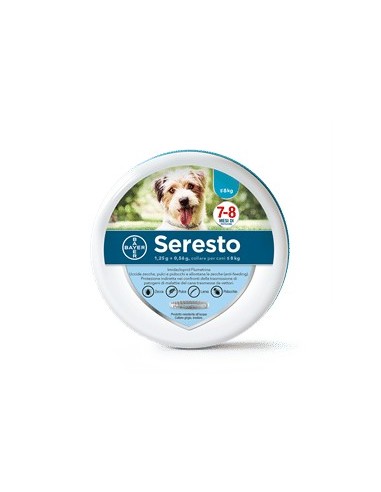
SERESTO 1.25 G + 0.56 G, COLLAR FOR DOGS <= 8 KG
Pharmacotherapeutic group
Ectoparasiticides, insecticides and repellents, pyrethrins and pyrethroids, flumethrin combinations.
Active substances
One 38 cm collar (12.5 g) contains as active substances 1.25 g of imidacloprid and 0.56 g of flumethrin. For the full list of excipients, see section 6.1.
Excipients
Titanium dioxide (E 171), black iron oxide (E 172), dibutyl adipate, propylene glycol dicaprylocaprate, epoxidised soybean oil, stearic acid, polyvinyl chloride.
Indications
For the treatment and prevention of flea infestation (Ctenocephalides felis, C. canis) for 7-8 months. Protects the animal's immediate surroundings against flea larval development for 8 months. Seresto can be used as part of a treatment strategy for the control of Flea Allergy Dermatitis (FAD). The product has persistent acaricidal (killing) efficacy against tick infestations (Ixodes ricinus, Rhipicephalus sanguineus, Dermacentor reticulatus) and repellent (anti-feeding) efficacy against tick infestations (Ixodes ricinus, Rhipicephalus sanguineus) for 8 months. The product is effective against larvae, nymphs and adult ticks. Ticks already on the dog prior to treatment may not be killed within 48 hours after application of the collar and may remain attached and visible. Therefore, removal of ticks already on the dog at the time of application is recommended. Prevention of infestations with new ticks starts within two days after application of the collar. The product provides indirect protection against the transmission of the pathogens Babesia canis vogeli and Ehrlichia canis by the tick vector Rhipicephalus sanguineus, thereby reducing the risk of canine babesiosis and canine ehrlichiosis for 7 months. Reduction of the risk of infection with Leishmania infantum via transmission by sand flies for up to 8 months. For the treatment of biting/chewing lice infestation (Trichodectes canis).
Contraindications/Side effects
Do not treat puppies under 7 weeks of age. Do not use in animals with hypersensitivity to the active substances or to any of the excipients.
Safety in the target species
Due to the nature of the collar, overdose is unlikely and signs of overdose are not expected. An overdose of 5 collars around the neck was studied in adult dogs for 8 months and in 7-week-old puppies for 6 months, and no adverse events were observed other than slight hair loss and mild skin reactions. In the unlikely event that the animal eats the collar, mild gastrointestinal symptoms (e.g. loose faeces) may occur.
Dosage
Cutaneous use. One collar per animal is to be fitted around the neck. Small dogs up to 8 kg body weight receive one 38 cm collar. Dogs over 8 kg receive one 70 cm collar for dogs > 8 kg. For external use only. Remove the collar from the protective pouch immediately before use. Unroll the collar and make sure there are no remnants of the plastic connecting strips inside the collar. Adjust the collar around the animal's neck without tightening it too much (as a guide, it should be possible to fit 2 fingers between the collar and the neck). Pull the excess collar through the loop and cut off any excess length beyond 2 cm. The collar should be worn continuously during the 8-month protection period and should be removed after the treatment period. Check periodically and adjust the fit if necessary, especially when puppies are growing rapidly. This collar has a safety release mechanism. In the extremely rare event of a dog getting trapped, the dog's own strength is usually sufficient to widen the collar to allow quick release.
Storage
This veterinary medicinal product does not require any special storage conditions. Shelf life of the veterinary medicinal product as packaged for sale: 5 years.
Warnings
Ticks will generally be killed and fall off the host within 24-48 hours after infestation without having had a blood meal. The attachment of single ticks after treatment cannot be excluded. For this reason, the transmission of infectious diseases by ticks cannot be completely excluded if conditions are unfavourable. Although a significant reduction in the incidence of Leishmania infantum in dogs has been demonstrated, the product has shown variable repellent (anti-feeding) and insecticidal efficacy against the sand fly Phlebotomus perniciosus. Consequently, sand fly bites may occur and transmission of Leishmania infantum cannot be completely excluded. The collar should be applied just prior to the beginning of the activity period of the sand fly vectors, corresponding to the Leishmania infantum transmission season, and should be worn continuously throughout the risk period. Ideally, the collar should be applied before the beginning of the flea or tick season. As with all long-term topical products, periods of excessive seasonal hair loss may lead to a slight, transient reduction in efficacy due to the loss of some of the active substances bound to the hair. Replenishment of the active substances from the collar starts immediately, restoring full efficacy without any additional treatment or collar replacement. For optimal control of the flea problem in heavily infested households, it may be necessary to treat the environment with a suitable insecticide. The product is water-resistant and remains effective if the animal gets wet. However, prolonged, intense exposure to water and extensive shampooing should be avoided, as the duration of activity may be reduced. Studies show that monthly shampooing or immersion in water does not significantly shorten the 8-month efficacy against ticks after redistribution of the active substances in the coat, whereas efficacy against fleas gradually decreases starting from the fifth month. The influence of shampooing or water immersion on the transmission of canine leishmaniosis has not been investigated. Special precautions for use in animals: Not applicable. Special precautions to be taken by the person administering the product to animals: Keep the pouch containing the collar in the outer carton until use. As with any veterinary medicinal product, do not allow small children to play with the collar or put it in their mouths. Do not allow animals wearing the collar to sleep in the same bed as their owners, especially children. Imidacloprid and flumethrin are continuously released from the collar to the skin and coat while the collar is worn. The product may cause hypersensitivity reactions in some people. People with known hypersensitivity (allergy) to the components of the collar should avoid contact with the veterinary medicinal product. In very rare cases, the product may cause skin, eye and respiratory irritation in some people. In case of eye irritation, rinse the eyes thoroughly with cold water. In case of skin irritation, wash the skin with soap and cold water. If symptoms persist, seek medical advice and show the package leaflet or the label to the doctor. Dispose of any remnants or cut-off pieces of the collar immediately (see section 4.9). Wash hands with cold water after fitting the collar. Due to the nature of the collar, overdose is unlikely and signs of overdose are not expected. An overdose of 5 collars around the neck was studied in adult dogs for 8 months and in 7-week-old puppies for 6 months, and no adverse events were observed other than slight hair loss and mild skin reactions. In the unlikely event that the animal eats the collar, mild gastrointestinal symptoms (e.g. loose faeces) may occur. Incompatibilities: none known.
Withdrawal periods
Not applicable.
Target species
Dogs (<= 8 kg).
Interactions
None known.
Diagnosis and prescription
Sale is not restricted exclusively to pharmacies and does not require a veterinary prescription.
Side effects
In rare cases, during the first few days after application, behavioural disturbances may be observed in animals not used to wearing collars, which may include hiding, vocalisation, hyperactivity, excessive licking and/or grooming, or scratching at the application site. Aggressiveness after fitting the collar has been reported in very rare cases. Make sure the collar is fitted correctly. Application site reactions such as itching, erythema and hair loss may occur. These reactions have been reported as rare and usually resolve within 1-2 weeks. In individual cases, temporary removal of the collar may be recommended until the symptoms have disappeared. In very rare cases, application site reactions such as dermatitis, inflammation, eczema, lesions or haemorrhage may occur; in these cases removal of the collar is recommended. In rare cases, neurological symptoms such as ataxia, convulsions and tremor may occur. In these cases removal of the collar is recommended. In addition, in rare cases in dogs, mild and transient reactions such as depression, change in appetite, salivation, vomiting and diarrhoea may initially occur. The frequency of adverse reactions is defined using the following convention: very common (more than 1 in 10 animals treated displaying adverse reactions), common (more than 1 but less than 10 animals in 100 animals treated), uncommon (more than 1 but less than 10 animals in 1,000 animals treated), rare (more than 1 but less than 10 animals in 10,000 animals treated), very rare (less than 1 animal in 10,000 animals treated, including isolated reports).
Pregnancy and lactation
Laboratory studies with both flumethrin and imidacloprid in rats and rabbits have not produced any effects on fertility or reproduction and have not shown any teratogenic or foetotoxic effects. However, the tolerability of the veterinary medicinal product during pregnancy and lactation has not been established in the target species and therefore, in the absence of available data, the product is not recommended in pregnant or lactating bitches.