Name
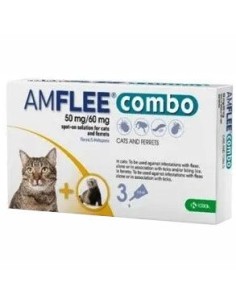
AMFLEE COMBO 67 MG/60.3 MG SPOT-ON SOLUTION FOR SMALL DOGS
Pharmacotherapeutic Category
Ectoparasiticides, insecticides and repellents.
Active Substances
Each 0.67 ml pipette contains the active substances: fipronil 67 mg; S-Methoprene 60.3 mg.
Excipients
Butylhydroxyanisole (E320) 0.134 mg, butylhydroxytoluene (E321) 0.067 mg, povidone (K25), polysorbate 80, ethanol 96%, diethylene glycol monoethyl ether.
Indications
For the treatment of dogs; the dosage is defined by body weight (see section 3.9): for use against flea infestations, alone or in combination with ticks and/or chewing lice; treatment of flea infestations (Ctenocephalides spp.). Insecticidal efficacy against new infestations with adult fleas persists for 8 weeks. Prevention of flea multiplication by inhibiting the development of eggs (ovicidal activity), larvae and pupae (larvicidal activity) originating from eggs laid by adult fleas for eight weeks after application; treatment of tick infestations (Ixodes ricinus, Dermacentor variabilis, Dermacentor reticulatus, Rhipicephalus sanguineu). The veterinary medicine has persistent acaricidal efficacy for up to 4 weeks against ticks; treatment of chewing lice infestations (Trichodectes canis). The veterinary medicine can be used as part of a treatment strategy for the control of Flea Allergy Dermatitis (FAD), where this has previously been diagnosed by a veterinary surgeon.
Contraindications/Undesirable Effects
In the absence of available data, the veterinary medicine should not be used in puppies under 8 weeks of age and/or weighing less than 2 kg. Do not use in sick (e.g. systemic disease, fever) or convalescent animals. Do not use in rabbits, due to the risk of adverse reactions or even death. This veterinary medicine is specifically developed for dogs. Do not use in cats and ferrets, as overdosing could occur. Do not use in cases of hypersensitivity to the active substances or to any of the excipients.
Safety in the Target Species
In target species safety studies, no adverse events were observed in 8-week-old puppies, growing dogs and dogs weighing approximately 2 kg treated once with five times the recommended dose. The risk of adverse events (see section 3.6) may however increase in the event of overdose, so animals should always be treated with the pipette of the correct dosage according to body weight.
Dosage
For external use only, spot-on use. Administer by topical application to the skin: one 0.67 ml pipette (67 mg fipronil + 60.3 mg S-methoprene) per dog weighing between 2 and 10 kg. This corresponds to the minimum recommended dose of 6.7 mg/kg fipronil and 6 mg/kg S-methoprene, by topical application to the skin. In the absence of safety studies, the minimum treatment interval is 4 weeks. Method of administration: 1- Remove the pipette from the sachet. Hold the pipette upright, twist and remove the cap. 2- Turn the cap over and place it on the other end of the pipette. Push and twist the cap to break the seal, then remove the cap from the pipette. 3- Part the animal's coat on the back at the base of the neck in front of the shoulder blades until the skin is visible. Place the tip of the pipette on the skin and squeeze the pipette several times to empty its contents completely and directly onto the skin in one spot. Temporary changes to the coat may be observed at the application site (clumped/greasy hair).
Storage
Store in the original package in order to protect from light and moisture. This veterinary medicine does not require any special temperature storage conditions. Shelf life of the veterinary medicine as packaged for sale: 2 years.
Warnings
Bathing/immersion in water within 2 days after application of the veterinary medicine and bathing more frequently than once a week should be avoided, as no studies have been carried out to investigate how these affect the efficacy of the veterinary medicine. Emollient shampoos may be used before treatment, but they reduce the duration of flea protection to approximately 5 weeks when used weekly after application of the veterinary medicine. Weekly bathing with a 2% chlorhexidine medicated shampoo did not affect efficacy against fleas during a 6-week study. For the treatment and control of Flea Allergy Dermatitis, it is recommended that allergic patients and all other animals in the household are treated regularly. Fleas on animals often infest the animal's basket, bedding and regular resting areas such as carpets and soft furnishings, which, in case of massive infestation and at the start of control measures, should be treated with a suitable insecticide and vacuumed regularly. Special precautions for safe use in the target species: the attachment of single ticks after treatment cannot be excluded. Therefore, the transmission of infectious diseases cannot be completely excluded if conditions are unfavourable. For external use only. Do not administer orally. Avoid contact with the animal's eyes. If the veterinary medicine comes into contact with the eyes, rinse immediately with plenty of water. Do not apply the veterinary medicine to wounds or skin lesions. It is important to make sure that the veterinary medicine is applied directly to an area of dry skin where the animal cannot lick it, and to make sure that animals do not lick each other after treatment. Wait for the application site to dry before allowing the treated dog to come into contact with valuable fabrics or furnishings. Special precautions to be taken by the person administering the veterinary medicine to animals: this veterinary medicine can cause irritation to mucous membranes, skin and eyes. Therefore, contact of the veterinary medicine with the mouth, skin and eyes should be avoided. People with known hypersensitivity to fipronil or S-methoprene and/or any of the ingredients should avoid contact with the veterinary medicine. Avoid contact of the contents with the fingers. If this happens, wash hands immediately with soap and water. In case of accidental contact with the eyes, rinse the eyes immediately and thoroughly with clean water. Wash hands after use. In case of accidental ingestion, seek medical advice immediately and show the package leaflet or the label to the doctor. Do not smoke, drink or eat during application. Treated animals should not be handled until the application site is dry, and children should not be allowed to play with treated animals until the application site is dry. It is therefore recommended that animals are not treated during the day but in the early evening, and that recently treated animals are not allowed to sleep with their owners, especially children. Keep the pipettes in the original package until use and dispose of used pipettes immediately. Special precautions for the protection of the environment: dogs should not be allowed to swim in watercourses for 2 days after application (see section 5.5). In target species safety studies, no adverse events were observed in 8-week-old puppies, growing dogs and dogs weighing approximately 2 kg treated once with five times the recommended dose. The risk of adverse events (see section 3.6) may however increase in the event of overdose, so animals should always be treated with the pipette of the correct dosage according to body weight. Incompatibilities: none known.
Withdrawal Periods
Not applicable.
Target Species
Dog 2 - 10 kg.
Interactions
None known.
Diagnosis and Prescription
Veterinary medicine not subject to prescription.
Undesirable Effects
Dogs. Very rare (< 1 animal / 10,000 animals treated, including isolated reports): hair loss at the application site ^1, itching at the application site ^1, redness at the application site ^1, skin discolouration at the application site ^1, itching, general hair loss, hypersalivation ^2, vomiting, neurological signs ^3, hyperaesthesia ^3, respiratory signs, depression ^3. ^1 Transient. ^2 If the animal licks itself, a brief period of hypersalivation may be observed due to the nature of the carrier. ^3 Reversible. Reporting adverse events is important as it allows continuous safety monitoring of a veterinary medicine. Reports should be sent, preferably via a veterinary surgeon, to the marketing authorisation holder or its local representative or to the national competent authority via the national reporting system. See the package leaflet for the respective contact details.
Pregnancy and Lactation
Pregnancy and lactation: can be used during pregnancy and lactation.