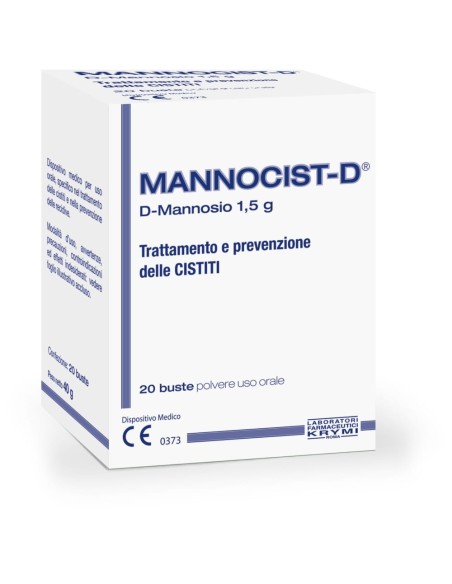
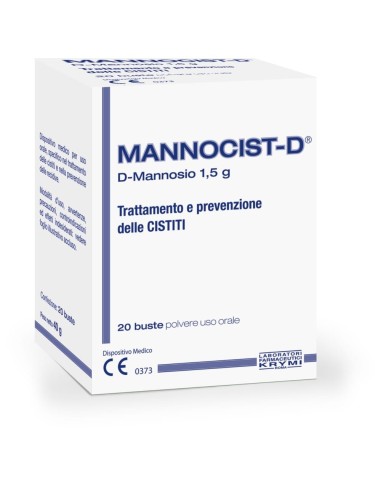
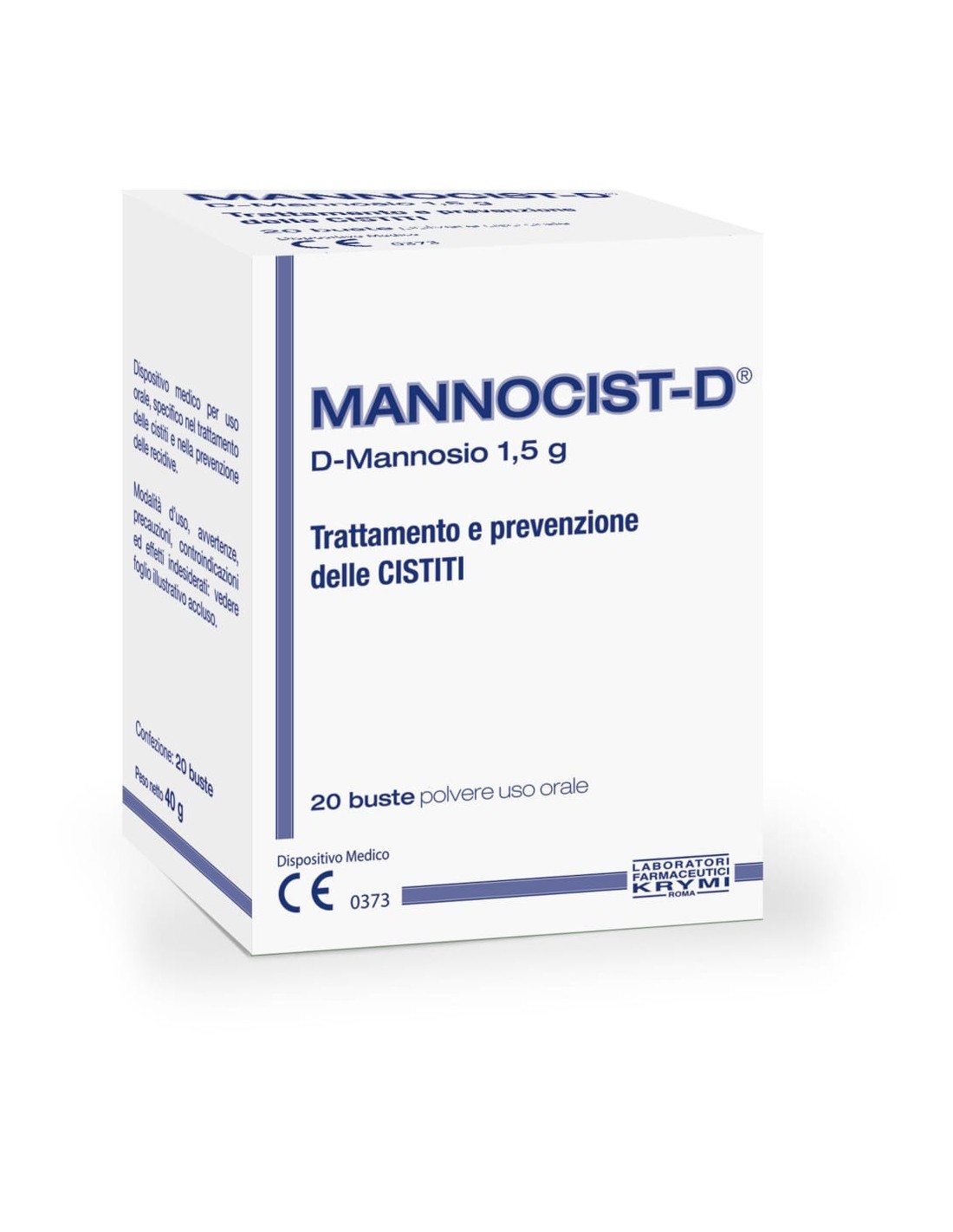
MANNOCIST-D
D-Mannose 1.5 g
Treatment and prevention
of CYSTITIS
CE 0373 Medical Device
INDICATIONS: Mannocist-D sachets, based on D-Mannose, is a medical device able to inhibit the adhesion of the bacteria responsible for urinary tract infections to the urethral and bladder epithelium, to promote their elimination in the urine and therefore to limit the onset of infections. D-Mannose can be used both in acute urinary tract infections and in their recurrence. Concomitant use of Mannocist-D with antibiotics and antimicrobials may support the effectiveness of the latter by increasing patient adherence to therapy.
COMPOSITION: D-Mannose 1.5 g, sodium bicarbonate, sorbitol, silicon dioxide.
DIRECTIONS FOR USE: acute phase: for the first 3 days, 1 sachet in the morning and 1 in mid-afternoon, on an empty stomach and with an empty bladder; maintenance phase: 1 sachet every morning, on an empty stomach and with an empty bladder, until symptoms have completely disappeared. If sexual intercourse is the trigger for cystitis, take 1 sachet after each intercourse and 2 sachets in the following 24 hours, as described above. Take the product by dissolving the contents of the sachet in half a glass of water, then do not drink or eat for about 40 minutes. During the rest of the day it is important to drink plenty of water to help eliminate bacteria through urination.
CONTRAINDICATIONS: cytotoxicity, sensitisation and oral mucosa irritation studies found no contraindications.
UNDESIRABLE EFFECTS: bloating may occur, which usually disappears after a few days.
PACK: 20 single-dose sachets of 2 g.
• Main features
- STRATEGY TO COUNTER UTIs (Urinary Tract Infections) AS AN ALTERNATIVE AND/OR SUPPORT TO ANTIBIOTIC AND ANTIMICROBIAL THERAPIES
- CLASS IIa MEDICAL DEVICE CERTIFIED BY THE ITALIAN NATIONAL INSTITUTE OF HEALTH (ISTITUTO SUPERIORE DI SANITÀ)
- D-MANNOSE 1.5 g PER SINGLE DOSE
- NO CONTRAINDICATIONS FOR USE ACCORDING TO THE BIOCOMPATIBILITY TESTS PERFORMED
-Cytotoxicity
-Allergic sensitisation
-Oral mucosa irritation.
- GLUTEN-FREE AND LACTOSE-FREE
- NICKEL TESTED Value found < 0.1 ppm
• D-Mannose
D-Mannose is a simple sugar, a hexose monosaccharide extracted from larch or birch wood, with a high safety profile. It is rapidly absorbed by the intestine and within a short time (30 min) distributed in the blood and to all organs(1). It cannot be converted into glycogen and is therefore not stored in the liver or other organs, nor is it used by the body(2). Excess mannose reaches the kidneys and bladder and is eliminated in the urine. Long-term administration of mannose, at concentrations of up to 20%, produced no effects on metabolism and no signs of toxicity, which supports its good general toxicological profile(3).
• D-Mannose activity on bacteria
The adhesion of bacteria to the surface of animal cells is a crucial factor for virulence and the onset of infections. This recognition-adhesion is often mediated by sugar residues such as D-Mannose and L-fucose, which bind to specific lectins on the bacterial surface. Several virulence factors are known and described that are more abundantly represented on pathogenic serotypes, for example of E. coli (known as UPEC, Uropathogenic Escherichia coli), Salmonella spp and other bacteria involved in urinary tract infections such as Proteus mirabilis(4)(5).
• D-Mannose in the management of UTIs
The bladder wall is lined with various mannosylated proteins, including Tamm-Horsfall proteins (THP), which interfere with the adhesion of bacteria to the epithelium. THP binds to E. coli with a highly specific and saturable bond, which is inhibited by D-Mannose(6), suggesting an important role of the mannosylated groups of THP in the specific binding, particularly with pathogenic coli carrying the FimH virulence factor, which are found more abundantly in patients with UTIs than in the healthy population. D-Mannose mimics the function of the urothelial barrier, inhibiting the adhesion of bacteria to the urethral and bladder epithelium. By binding to free D-Mannose molecules in the urine, instead of nesting in the mucosal walls, bacteria remain trapped in the urine flow and are eliminated with it. In vitro and in vivo studies have shown the ability of mannosides to reduce the bacterial load by 2 orders of magnitude in the urine and by 4 in the bladder(7).
• Conclusions
There is a strong and well-established scientific rationale regarding the effectiveness of D-Mannose in inhibiting the adhesion of the bacteria responsible for UTIs, promoting bacterial clearance via the urine and thus reducing the onset of infections(8-10). The nature of the monosaccharide and long-term studies support the fact that it is free of toxicity even when ingested at doses much higher than those normally found in the diet(3).
BIBLIOGRAPHY
1. Alton G, Hasilik M, Nieheus R, Fana F and Freeze HH.Direct manipulation of mannose for mammalian glycoprotein biosynthesis. Glycobiology. 1998;8:285-295
2. Sharon N. Carboydrates as future anti-adhesion drugs for infectious diseases Biochim Biophys Acta. 2006 Apr;1760(4);527-37. Epub 2006 Jan 18
3. Davis JA, Freeze HH: Studies of mannose metabolism and effects of long-term mannose ingestion in the mouse. Biochim Biophys Acta,. 2001 Oct 3;1528(2-3):116-26
4. Rosen DA. Pinkener JS, Walker JN, Elam JS, Jones JM, Hultgren SJ.Molecular variations in Klebsiella pneumonia and Escherichia coli FimH affect function and pathogenesis in the urinary tract. Infect Immun. 2008 Jul;76(7):3346-56. Epub 2008 May 12
5. Zunino P., Sosa V, Schalapp G, Allen AG, Preston A, Maskell DJ. Mannose-resistant Proteuslike and P.mirailis fimbriae have specific and additive roles in P.mirabilis urinary tract infections. FEMS Immunol Med Microbiol. 2007 Oct-,51(1):125-33
6. Pak J, Pu Y, Zhang ZT, Hasty DL, Wu XR. Tamm-Horsfall protein binds to type 1 fimbriated Escherichia coli and prevents E.coli form binding to uroplakin Ia and Ib receptors. J Biol Chem. 2001 Mar 30; 276(13):9924-30. Epub 2000 Dec 27.
7. Klein t, Abgottspon D, Wittwer M, Rabbani S, Herold J, Jiang X, Kleeb S, Luthi C, Scharenberg M, Bezencon J, Gulber E, Pang L, Smiesko M, Cutting B, Schwardt O, Ernst B. FimH antagonists for the oral treatment of urinary tract infections: from design and synthesis to in vitro and in vivo evaluation. J Med Chem. 2010 Dec 23;53(24):8627-41. Epub 2010 Nov 24
8. Lopez AI, Kumar A, Planas MR, Li Y, Nguyen TV, Cai C. Biofunctionalization of silicone polymers using poly (amidoamine) dendrimers and a mannose derivative for prolonged interference against pathogen colonization. Bimaterials. 2001 Jul;32(19):4336-46. Epub 2011 Mar 24
9. Kim J, Ahn Y, Park KM, Lee DW, Kim K. Glyco-psudopolyrotaxanes: carbohydrate wheels threaded on a polymer string and their inhibition of bacterial adhesion. Chemistry. 2010 Oct 25;16(40):12168-73
10.Han Z, Pinkner JS, Ford B, Obermann R, Nolan W, Wildman SA, Hobbs D, Ellenberger T, Cusumano CK, Hyltgren SJ, Jaetka JW. Structure-based drug design and optimization of mannoside bacterial FimH antagonists. J Med Chem. 2010 Jun 24;53(12):4779-92